What Is an LED Driver? Types, Wiring and Troubleshooting
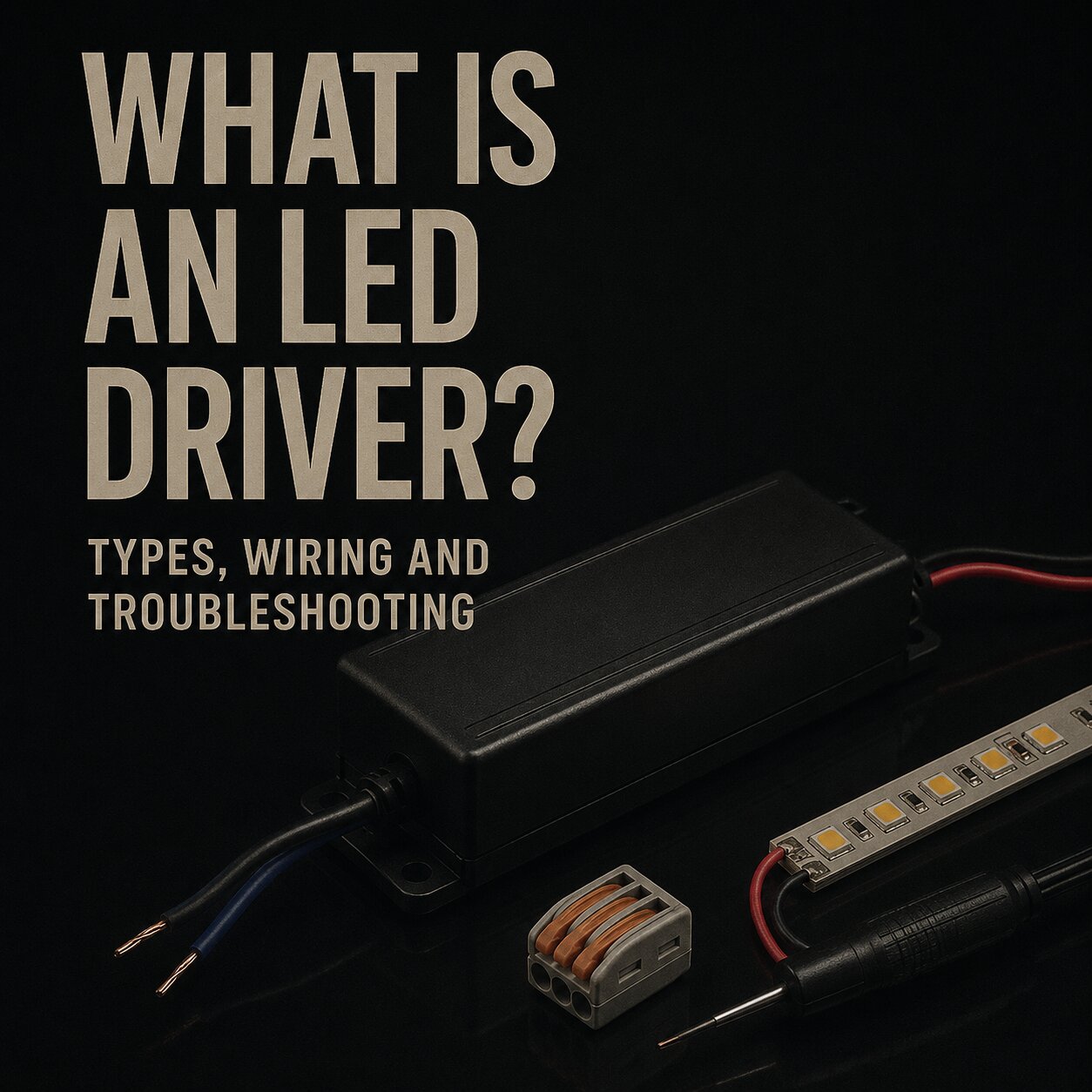
An LED driver is the power supply that sits between your electrical system and the LEDs themselves. Its job is to convert incoming power into the stable, regulated current the LEDs need to run correctly.
It is also the component most likely to fail. When an LED fixture flickers, dims unevenly, or dies years before its rated lifespan, the driver is usually the culprit rather than the LEDs.
What Does an LED Driver Do?
LEDs are current-driven devices, not voltage-driven. That single fact explains why they need a driver at all.
Feed an LED slightly too much current and it runs hotter than designed, degrading the semiconductor junction and shortening its life. Feed it inconsistent current and the output flickers. Left unregulated, an LED will also draw progressively more current as it heats up, which raises its temperature further, which increases current draw again. This runaway cycle destroys the LED in short order.
The driver prevents all of this. It holds current steady regardless of what the input voltage is doing, and it protects the LEDs from the spikes and sags that occur in any real electrical system.
In vehicle applications this matters more than most people expect. Vehicle voltage swings constantly with engine load, alternator output, and accessory switching, and a cheap driver simply passes those swings through to the LEDs.
Constant Current vs Constant Voltage LED Drivers
There are two main types and picking the wrong one is a common mistake.
| Constant current | Constant voltage | |
|---|---|---|
| Regulates | Current (mA or A) | Voltage (12V, 24V) |
| Output | Fixed current, variable voltage | Fixed voltage, variable current |
| Used for | Individual LEDs and modules without built-in resistors | LED strips and fixtures with onboard current regulation |
| Specified as | e.g. 700 mA, 30 to 42V | e.g. 24V, 60W max |
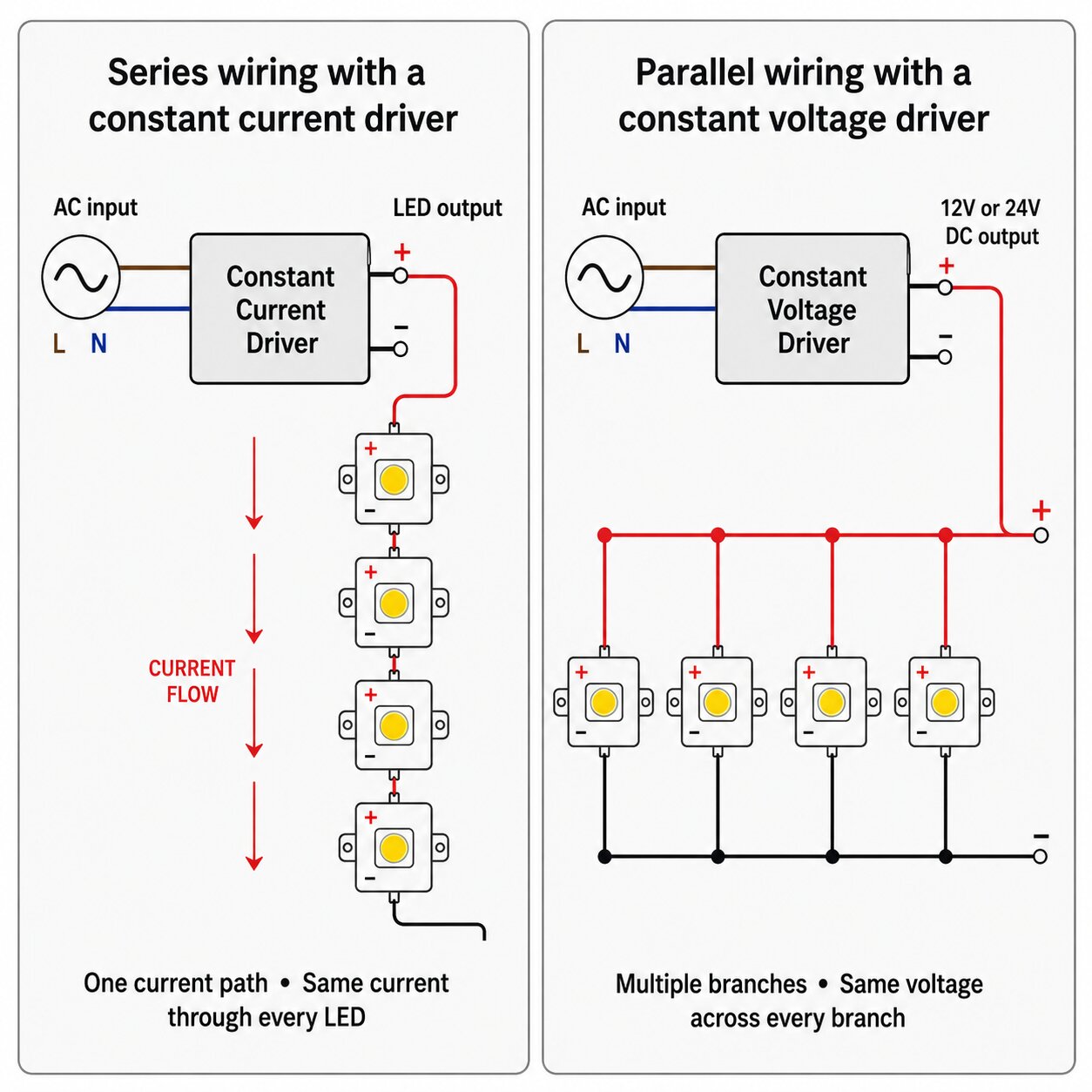
A constant current LED driver holds the current at a fixed value and adjusts voltage as needed. This is the correct choice when the LEDs have no current regulation of their own, which covers most high-power LED modules and arrays.
A constant voltage LED driver holds voltage steady at 12V or 24V and lets the load draw whatever current it needs. LED strips and many finished fixtures include their own resistors or regulators, so they need a stable voltage rather than a stable current.
Check the LED specification before choosing. If it lists a current rating in milliamps, you need constant current. If it lists a voltage, you need constant voltage.
How to Choose an LED Driver
Four things determine whether a driver is right for the job.
Output type. Constant current or constant voltage, as above. Get this wrong and nothing else matters.
Output rating. For constant current, match the driver current to the LED current rating and confirm the LED forward voltage falls inside the driver’s output voltage range. For constant voltage, match the voltage exactly and size the wattage above the total load.
Headroom. Size the driver for around 20 percent more wattage than the load actually needs. A driver running permanently at its limit runs hot, and heat is what kills drivers.
Input voltage. Confirm the driver accepts your supply. AC to DC drivers convert mains power, while DC to DC drivers run from a battery or vehicle system. A 12V LED driver in a 24V truck will fail immediately unless it is rated for the full range.
For military and commercial vehicle work, look for drivers with a wide input range covering 9 to 32V. These handle both 12V and 24V platforms and tolerate the voltage transients defined in MIL-STD-1275.
Dimmable LED Drivers
A dimmable LED driver adds output control, but only if the dimming method matches the rest of the system.
PWM dimming switches the output on and off very rapidly. The LED runs at full current whenever it is on, so color temperature stays consistent across the whole dimming range. This is the standard approach in vehicle and tactical lighting.
Analog or CCR dimming reduces the current itself. It is simpler but can shift color slightly at low output and often will not dim smoothly below about 10 percent.
0-10V and DALI are control protocols used in commercial installations where dimming is managed by a building system rather than the driver alone.
Wiring a dimmable driver follows the same process as a standard one, with the dimming control wires connected separately from the power input. Always check whether the driver expects a 0-10V signal, a PWM signal, or a mains dimmer, since these are not interchangeable.
How to Wire an LED Driver
The basic sequence is the same for almost every installation.
- Isolate the power supply before touching anything
- Connect the input side of the driver to the supply, matching live, neutral, and earth for AC or positive and negative for DC
- Connect the output side to the LED load, observing polarity
- For constant current drivers, wire multiple LEDs in series so the same current passes through each one
- For constant voltage drivers, wire in parallel so each load sees the full voltage
- Connect dimming control wires if applicable
- Restore power and confirm operation before sealing the installation
Series and parallel is the step people get wrong most often. A constant current driver wired in parallel splits its current unevenly between branches, which produces mismatched brightness and premature failure.
How to Tell if an LED Driver Is Bad
Driver failure has a fairly consistent set of symptoms.
- Flickering or strobing, especially at low output
- Fixture works intermittently or cuts out after warming up
- Reduced brightness with no change to the LEDs themselves
- Buzzing or high-pitched whine from the driver housing
- Complete failure with LEDs that test fine on another supply
Flickering is by far the most common. Our guide on flickering LED lights covers the full range of causes, since wiring faults and voltage drop produce similar symptoms.
To test a driver, measure the output with a multimeter while it is connected to its normal load. A constant voltage driver should read close to its rated voltage. A constant current driver should read within its stated output voltage range. Readings that are zero, wildly off, or unstable point to a failed driver.
A quicker check is substitution. Connect the LEDs to a known good driver of the correct type. If they work normally, the original driver is the problem.
LED Driver Replacement
Replacing a driver is usually far cheaper than replacing a whole fixture, and in many cases it is the only part that has actually failed.
Match the replacement on output type, output rating, input voltage, and dimming method. Physical size and mounting matter too, particularly in sealed fixtures where space is tight.
One thing to check first: in integrated LED fixtures the driver is often not separable from the housing. If the fixture is fully sealed with no serviceable driver, replacement of the unit is the only option. This is a deliberate design trade-off covered in our article on LED lighting, where integrating the driver improves reliability at the cost of serviceability.
Frequently Asked Questions
The number refers to the output voltage for constant voltage drivers, or in some cases the input voltage range. A 12V driver powers 12V LED strips and modules, and a 24V driver powers 24V loads. They are not interchangeable. Running a 24V strip from a 12V driver produces dim, unstable output, while the reverse will destroy the LEDs. In vehicle applications, look for wide-input drivers rated 9 to 32V that cover both systems.
An LED driver IC is the integrated circuit at the heart of the driver that performs the actual current regulation. It is a component rather than a finished product. Manufacturers select driver ICs when designing a fixture, so this is usually only relevant if you are designing or repairing driver circuits rather than specifying lighting.
Only if the LEDs already have current regulation built in, which some retrofit bulbs and finished fixtures do. Running bare LEDs directly from a power source without any current limiting will cause thermal runaway and rapid failure, often within seconds at higher power levels.