


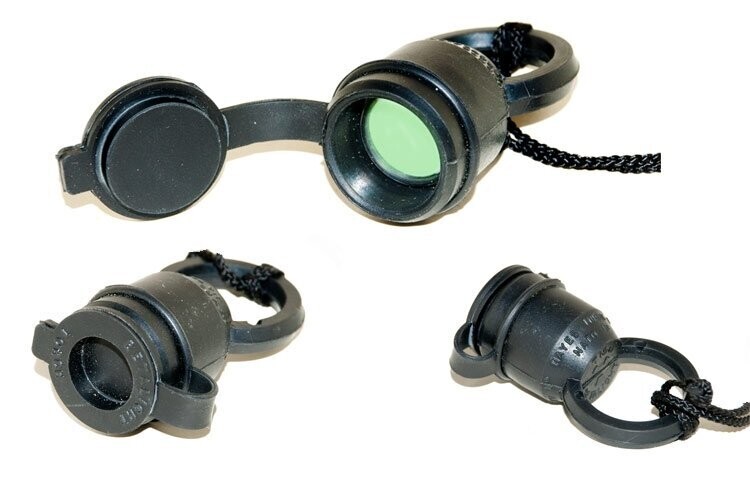

Key Features
- Maintenance-free. No batteries, no bulb, nothing to switch on
- Light weight, 45 g complete
- Output optimised for reading rather than for range
- Continues to work normally when wet or fully immersed in water
- Smooth non-slip casing and ergonomic design
- Recessed light source and hinged front cover allow graduated light exposure, so output can be controlled to the task
- Service life of 10 years, with usable output well beyond it
- NATO Stock Number 6260-99-965-3582, listed in our NSN product list
- Operates between -60 °C and +70 °C

Carried on Apollo
Betalight torches were carried among the personal belongings of Apollo astronauts, chosen for the same reason they are still specified today: a light that needs no power works when nothing else is available, and takes up no part of a mass or energy budget.
No spares were carried.

Performance
The self-luminous flight light torch produces green light at a brightness of 1,000 microlamberts (µL), giving practical illumination over an area of roughly 10 cm². Green is used because it is the colour the human eye resolves best at low light levels.
Brightness is unaffected by temperature, humidity, altitude or orientation, and there is no warm-up, no switch and no failure point. Light output comes from a sealed tritium light source and declines gradually and predictably over years rather than stopping.
Fixing
The torch incorporates a ring and neck cord for carrying, handling and temporary fixing to support structures or pickets.
Typical Applications
- Night navigation, enabling map and compass reading in tactical situations without a light source that can be seen at distance
- Dark area illumination where introducing a powered light is impractical or unwise
- Diving, where the torch continues to work fully immersed
- AFV fire control equipment illumination
- Military and law enforcement use worldwide
- General indoor and outdoor use, including emergency kits where equipment may sit unused for years
For map work specifically, see also our tritium map reader and tritium compass, or browse the full tritium range.
Materials
The inner housing is tough polycarbonate. The outer body and hinged front cover are black neoprene rubber, and a nylon cord is attached to the fixing ring.
Specifications
| Overall length | 77 mm |
| Diameter | 35 mm |
| Weight | 45 g |
| Brightness | 1,000 µL (microlamberts), green |
| Operating temperature | -60 °C to +70 °C |
| Housing | Polycarbonate inner, neoprene rubber outer |
| Service life | 10 years nominal |
| NATO Stock Number | 6260-99-965-3582 |

Frequently Asked Questions
Neither. The tritium light source glows continuously from the moment it is made, with no battery, no bulb and no switch. There is nothing to check before deployment and nothing to fail in storage, which is the practical reason it is issued rather than a powered torch.
1,000 microlamberts, illuminating roughly 10 cm². That is enough to read a map or work on something at arm’s length, and deliberately not enough to light a path or be seen at distance. The hinged cover lets you reduce it further, so the amount of light released can be matched to how much cover you have.
Yes. It operates between -60 °C and +70 °C and remains fully functional underwater. Brightness does not change with temperature, humidity, altitude or orientation, which is not true of battery-powered lights, whose output drops sharply in cold.
Tritium has a half-life of 12.3 years, so the glow diminishes gradually rather than stopping. Ten years is the nominal service life, and many units remain usable for 20 to 25 years depending on how much light the task requires. At end of life the torch can be returned through our take-back programme. See how long tritium lasts and tritium disposal and recycling.
Yes. The tritium is sealed inside a glass capsule within the torch body, and the beta radiation it emits cannot pass through the glass, so an intact unit presents no external dose. Our tritium safety article covers handling, breakage and storage in full.
