


Features
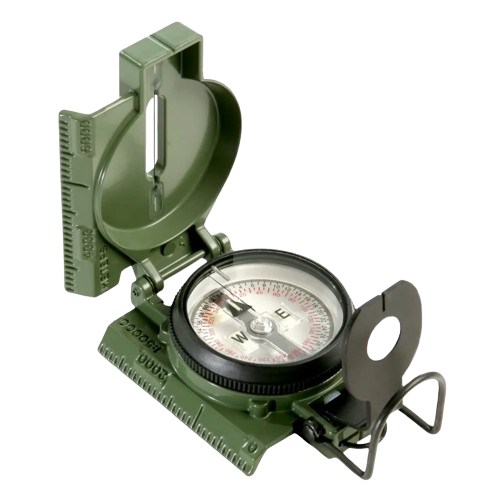
- Readable in total darkness: self-luminous tritium markings glow without a battery, a switch or charging by light, so the dial can be read without a torch.
- Bearings set by feel: the bezel ring clicks in 3 degree steps, 120 clicks per turn, so a bearing can be preset by counting clicks when the dial cannot be seen.
- Sight and read in one movement: the user aims through the sighting wire and reads the dial through the lens at the same time, without lowering the compass.
- Fast, steady needle: induction damping slows and settles the needle quickly, so readings can be taken without a long wait for the needle to stop swinging.
- No fluid to fail: because the needle housing holds no liquid, heat and cold do not change how the needle behaves.
- Degrees and mils: the dial carries both scales, so bearings can be passed in mils to fire support teams and in degrees for general navigation.
What is a tritium lensatic compass?
A tritium lensatic compass is a magnetic sighting compass for land navigation with a magnifying lens, a sighting wire and self-luminous markings. The Tritium Compass 3H is the tritium version of the M-1950 pattern lensatic compass issued to US Army and Marine Corps units, listed under NSN 6605-01-196-6971.
Its markings are lit by tritium vials: sealed glass capsules filled with tritium gas, whose beta particles make a phosphor coating glow (read more about tritium illumination). For the full method of taking and following a bearing, see our guide on how to use a lensatic compass.
Two dots on the sighting wire, a line on the crystal, a line on the north arrow, dots under W and E, and a short line on the bezel.
120 clicks per turn, 3 degrees per click. A bearing of 45 degrees is 15 clicks from north.
Truck or tank 18 m, barbed wire 10 m, machine gun 2 m, rifle 0.5 m.

Specifications
| Illumination | 7 Tritium betalights, providing continuous illumination for over 12 years |
| Accuracy | +/- 40 mils |
| Operating temperature | -50° F to 150° F |
| Damping | Copper induction-damping ring |
| Needle housing | Non-liquid filled |
| Frame | Powder-coated, aluminum frame |
| Protection | Shockproof, damage-resistant; waterproof to considerable depths; sandproof |
| Hemisphere | Northern / Southern |
| Colours | Black / Olive Drab / Coyote Brown / Pink |
| Material | Tritium / Phosphorescent |
| NSN | 6605-01-196-6971 |

The 3H Keeps Patrols Navigating When GPS Fails
GPS can be jammed and every receiver needs power. The 3H needs neither, so it remains the fallback for patrols, forward observers and vehicle crews when GPS is denied. Its seven tritium points light the sighting wire, the north arrow and the bezel line, so a bearing set by day can be followed in the same way at night.
Its NSN lets logistics staff order the 3H as a like-for-like replacement. Vehicle crews should walk clear of the vehicle before taking a bearing, because the steel hull deflects the needle.

Frequently Asked Questions
Order the version for the area of operations. The Earth’s magnetic field dips more steeply into the ground towards the poles, so the needle is weighted to stay level against that vertical pull in one hemisphere. A needle balanced for the other hemisphere sits out of level and may not swing freely. Units that deploy both north and south of the equator should hold stock of both versions.
Tritium glows continuously without any charging. Phosphorescent markings must first be exposed to light, are bright at first and fade within hours, so they suit units that cannot hold radioactive materials or that only navigate at night occasionally. For regular night navigation, choose tritium.
Choose the 3H for land navigation: it is sighted through a wire and lens, reads in degrees and mils for passing bearings to fire support, and is the pattern issued to US forces. For bearings taken from a vessel, choose our tritium hand bearing compass. It is read through a prism that removes parallax, has one degree graduations, hangs from a neck cord and is waterproof to 50 m.
The manufacturer rates the 3H’s tritium illumination for over 12 years. Tritium has a half-life of 12.3 years, so the markings dim gradually rather than going out. Check each compass in darkness: all seven luminous points should be visible. Do not hold it under a light first, because that can make a worn compass look serviceable. Return worn or damaged compasses through regulated channels and never open one (see tritium safety).
