

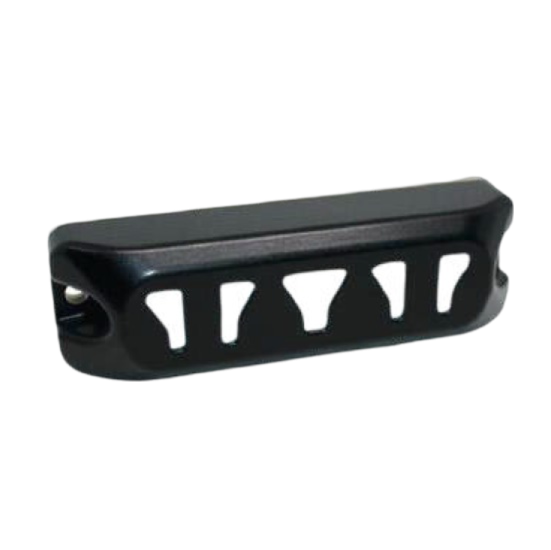
Features
- Two blackout functions in one unit: a steady rear blackout marker, and a blackout stop signal that lights when the brakes are applied.
- Controlled low-signature output: bright enough for the driver behind to hold the convoy interval, low enough to keep the column dark to distant observers.
- Visible or infrared versions: infrared options at 850 nm and 940 nm for convoys that drive on night vision devices.
- Works with the main light switch: operates in the BO MARKER and BO DRIVE positions of the vehicle’s blackout lighting circuit.
- Part of a complete blackout system: pairs with front blackout markers and a blackout driving light for a full STANAG 4381 style layout.
- Solid-state LED: no filament to break under shock and vibration, and instant response when the brakes are applied.
- Configurable part number: voltage, light colour and connector can be specified to match the vehicle, including a 12 V DC version.
What is a blackout rear and stop marker?
A blackout rear and stop marker is the rear lamp a military vehicle shows when it drives under blackout conditions. With the service lights switched off, it is the only light the next driver in the column sees: a steady marker that shows where the vehicle is, and a stop signal that shows when it is slowing down.
NATO guidance for these systems is set out in STANAG 4381, Blackout Lighting Systems for Tactical Land Vehicles, which groups them with the front blackout markers and the blackout driving light. US military blackout stop, tail and marker lamps have traditionally been designed to be visible at about 245 m (800 ft), invisible beyond about 365 m (1,200 ft), and not visible from aircraft flying above about 120 m (400 ft).
Convoy Discipline Without Giving the Column Away
At night, a convoy under blackout keeps its spacing by the rear marker of the vehicle ahead. If that marker is too bright, it can be seen well beyond the column. If it is too dim or fails, drivers close up or lose contact. The blackout stop signal adds the warning a driver needs most in the dark: that the vehicle ahead is braking, which a steady marker alone cannot show.
The infrared versions go a step further. At 850 nm or 940 nm the marker is seen only through night vision devices, so a convoy on night vision shows no visible light at all. 850 nm appears brighter through night vision but gives off a faint red glow at close range. 940 nm has no visible glow but appears dimmer through night vision. The right choice depends on the devices your drivers use and the signature the mission accepts.

Specifications
| Description | 60mm Blackout Front, Rear, and Stop Marker Lights |
| Input Voltage | 24 V DC |
| Current Draw | 0.025A @ 24V DC |
| Outer Lens Material | Polycarbonate |
| Outer Lens Colour | Clear |
| Housing Material | Nylon |
| Housing Colour | Black |
| Mounting Type | Flange Mount |
| Min & Max Operating Temperature | -40 °C / -40 °F to 85 °C / 185 °F |
| Connector | Deutsch DT04-2P / DT06-2S |
| Wiring | Red wire: Positive; Black wire: Ground |
| Standards | Sealed to IP 67; Meets MIL-PRF-32212A, MIL-PRF-32214, MIL-PRF-32215A; MIL-STD-461F EMC Compliance, MIL-STD-810, STANAG-1838 |

Integration and Configuration
The marker is fitted at the rear of the vehicle, usually in pairs, and wired into the blackout lighting circuit so that the main light switch controls it. For a complete system, combine it with our blackout front marker and a blackout driving light from the blackout lighting range. The part number is built from the configuration chart on this page, so voltage, light colour and connector match the vehicle before the first unit ships.
Frequently Asked Questions
It is wired into the vehicle’s blackout lighting circuit. On a typical military main light switch it is lit in the BO MARKER and BO DRIVE positions, and the stop signal lights when the brakes are applied. In SER DRIVE the blackout lights are off and the service lighting is used.
A visible marker suits convoys where drivers see with the naked eye. An infrared marker suits convoys that drive on night vision devices and must show no visible light. Choose 850 nm for a brighter image through night vision, or 940 nm when even the faint red glow of 850 nm is not acceptable.
In many cases, yes. Check the mounting footprint against the dimension drawing on this page and confirm the voltage and connector for your vehicle. If the platform needs a different connector or voltage, specify it through the part number configuration or contact us.
