

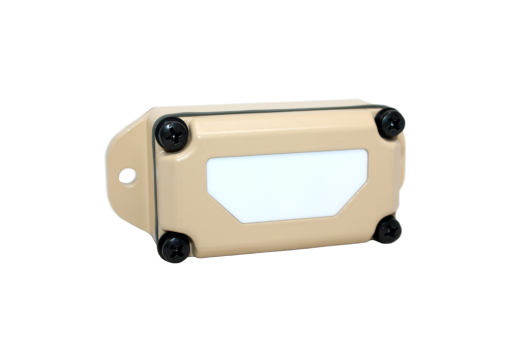
Features
- Front position under light discipline: shows friendly forces ahead of the vehicle where it is when the headlamps and service lights are switched off.
- A marker, not a lamp to drive by: it identifies the vehicle without lighting the ground ahead, so it adds as little light as possible to what an observer could detect.
- Fitted as a pair: one marker on each side of the front shows the presence and width of the vehicle, which matters on narrow routes and at halts.
- Lit in both blackout positions: the markers work with the blackout marker setting alone and together with the blackout drive lamp, selected from the vehicle’s main light switch.
- One front blackout set: listed to the same three standards as the Betalight blackout drive lamp, so the front of the vehicle can be specified and qualified as one set.
- Made for the vehicle, not the shelf: supply voltage, housing colour and connector are chosen to suit the platform, so the marker fits an existing harness and paint scheme.
What is a blackout front marker?
A blackout front marker is a low-output position lamp at the front of a military vehicle. It is used when the vehicle moves or halts under blackout conditions, with the headlamps and service lights off. Front blackout markers are usually mounted below or beside the normal headlamps, one on each side.
The front marker is one of four lamp types in a vehicle blackout lighting system: front blackout markers, the blackout drive lamp, rear blackout markers and blackout stop lights. NATO STANAG 4381, Blackout Lighting Systems for Tactical Land Vehicles, gives member nations guidance on the design and application of these systems. The full range of military blackout lights covers each of these positions.
Front blackout markers: lit
Rear blackout markers: lit
Blackout stop lights: when the brakes are applied
Blackout drive lamp: off
Front blackout markers: lit
Rear blackout markers: lit
Blackout stop lights: when the brakes are applied
Blackout drive lamp: lit
Integration and Ordering
Two markers are normally fitted per vehicle. Use the dimension drawings to check the mounting footprint and the clearance behind the panel. When ordering, state the supply voltage (12V or 24V DC), the housing colour from the 13 military options and the connector configuration that matches the vehicle harness.
For forward vision under blackout, add the blackout drive lamp. At the rear, the blackout rear and stop marker completes the set, and convoy lights help following vehicles keep their spacing.
Specifications
| Input Voltage | 12V or 24V DC |
| Outer Lens Material | Polycarbonate |
| Housing Material | Aluminum |
| Housing Colors | 13 Military Color Options |
| Mounting Type | Panel Mount |
| Operating Temperature | -40°C to 65°C |
| Weight | 0.155 kg |
| Connector Options | 5 different configurations |
| Sealing Rating | IP68 – Waterproof & Dustproof |
| Military Standards | MIL-STD-461F, MIL-STD-810F, STANAG 4381 |

Front Position Marking Under Light Discipline
At night under blackout, a column moves without headlamps so that it cannot be seen from a distance or from the air. The crews still need to know where each vehicle is. Rear blackout markers tell the driver behind how far back to stay; the front markers tell anyone ahead of the vehicle that it is there and how wide it is, without lighting the route.
The marker is listed to MIL-STD-461F, the US standard for the control of electromagnetic interference, so it neither disturbs nor is disturbed by the radios and electronics on the vehicle. It is also listed to MIL-STD-810F, the environmental test method standard covering temperature, shock, vibration, rain and dust. If your programme calls up a later revision of either standard, raise it at the enquiry stage.

Frequently Asked Questions
It marks the front of a military vehicle when the headlamps and service lights are off. The marker shows friendly forces ahead of the vehicle where it is and, fitted as a pair, how wide it is. It is a position marker, not a lamp to drive by: forward vision under blackout comes from the blackout drive lamp.
On US military vehicles the main light switch has a BO MARKER position, which lights the blackout marker lights, and a BO DRIVE position, which lights all blackout lights, including the blackout drive lamp. The front markers are lit in both. In the SER DRIVE position the service lights are used instead. The exact switching depends on the vehicle’s own light switch and wiring.
Two, one on each side of the front, usually below or beside the headlamps. Together with one blackout drive lamp, two rear blackout markers and the blackout stop lights, they make up the vehicle’s blackout lighting.
The specification of this marker does not list an infrared output or wavelength. If your programme needs front marking that is visible only through night vision devices, state this in your enquiry so that the right configuration can be confirmed.
MIL-STD-461F for electromagnetic interference, MIL-STD-810F for environmental testing and STANAG 4381 for blackout lighting systems on tactical land vehicles. The sealing rating is IP68, which means dust-tight and protected against continuous immersion in water.
The supply voltage (12V or 24V DC), the housing colour from the 13 military colour options and the connector, which is available in five configurations. Order two markers per vehicle, and state any later standard revisions your programme requires.
