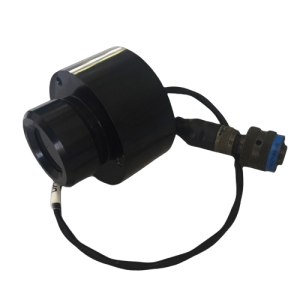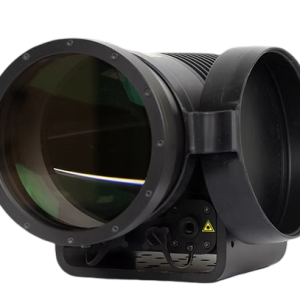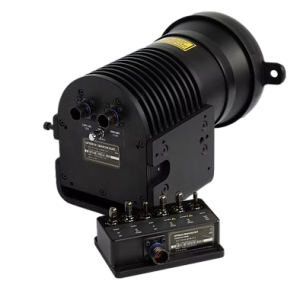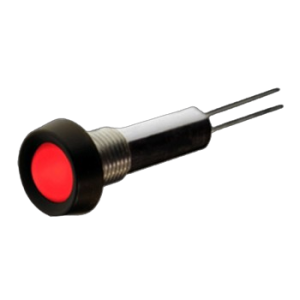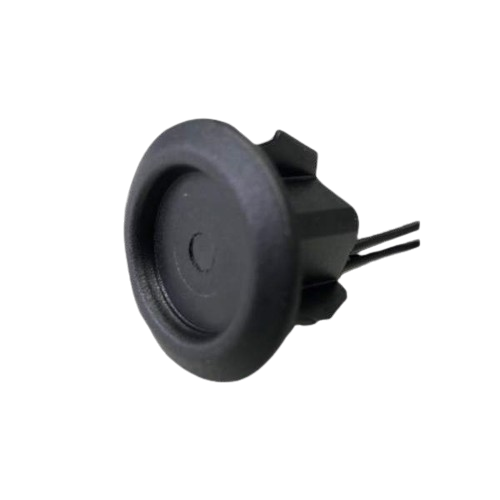
Features
- Marks the vehicle ahead: gives the driver behind, on night vision goggles, a fixed point of light on the rear of the vehicle in front, so it can be found and followed.
- Braking warning in the infrared: tells the following driver that the vehicle ahead is slowing, without showing a visible stop lamp.
- Distance cue from a pair of lamps: fitted as a pair, the two points of light appear further apart as the gap closes, which helps the driver judge distance where goggles limit depth perception.
- Matched to image intensifiers: emits in the near-infrared band that Gen II and Gen III night vision tubes detect and the unaided eye does not.
- Minimal visible signature: an integrated IR filter keeps visible light from the lamp to a minimum.
- Discreet appearance: the small round lens looks like a parking sensor (PDC, park distance control) rather than a lamp, so the fitting draws no attention on the rear body.
- Compact and solid-state: small enough for a bumper or rear panel, with LEDs and no filament to fail under shock and vibration.
What is an infrared convoy brake light?
An infrared convoy brake light is a rear lamp that emits near-infrared light instead of visible light. A driver wearing night vision goggles sees it as a clear point of light; to the unaided eye it shows little or nothing. It does for a convoy driving on goggles what the tail and stop lamps do in normal driving: it shows where the vehicle ahead is and when it is braking. It is one part of infrared vehicle lighting, alongside IR driving lights at the front and IR markers.
Second generation image intensifier tubes respond from about 400 nm to about 900 nm and third generation tubes from about 600 nm to a little over 900 nm. The 850 to 940 nm output of this lamp therefore sits in the band the goggles see and the eye does not. Two lamps are normally fitted at the rear, one towards each side. Where a single lamp must combine an IR tail marker and a brake function with screw mounting, see the infrared tail light.
Fitting and Wiring
Fit the two lamps facing rearwards, at the same height and as far apart as the rear body allows: wider spacing gives a clearer distance cue. Each lamp connects to the vehicle harness through a flying lead. Wire the lamps so that they are lit only when the crew selects blackout or night vision driving, and so that the braking warning follows the brake circuit.
For forward vision on goggles, combine the lamps with ir driving lights at the front. See the full range of infrared military vehicle lights for the same vehicle.
Well inside the response of Gen II and Gen III tubes, so it looks brighter in the goggles
Can show a faint dull red point to the unaided eye at close range
No visible glow to the unaided eye
At the edge of Gen III response, so it looks dimmer in the goggles
Specifications
| Current | Max 50mA @ 12V |
| Height | 18.0 mm |
| Width | 31.0 mm |
| Shape | Round |
| Outer Lens Material | Polycarbonate |
| Outer Lens Color | Clear |
| Housing Material | Nylon |
| Housing Color | Black |
| Operating Temperature | -40 °C to 80 °C |
| Connector or Wiring | Flying lead |
| Standards | MIL-STD 461G, IP68 |
| Wave Length | 850 to 940 nm |
| Voltage | 9 V to 33 V |

Convoy Spacing on Night Vision, Without a Visible Signature
When a convoy drives on night vision goggles, visible vehicle lights are switched off or masked, because they degrade the goggle image and give the vehicle away. The driver behind still needs to know where the vehicle ahead is and when it brakes, and goggles give their best depth perception only between about 20 and 500 feet. The convoy brake light puts both signals in the infrared, where the goggles see them, and the pair of lamps supports the judgement of distance.
The 9 V to 33 V input covers 12 V and 24 V vehicle systems, the draw is small, and the MIL-STD-461G listing addresses electromagnetic interference with radios and vehicle electronics. Infrared is covert to the eye, not to night vision: an opposing force with goggles can see it too. Use the lamps under the unit’s light discipline orders, together with military blackout lights for driving without goggles.
Frequently Asked Questions
Two lamps a fixed distance apart give the driver behind a cue to distance: as the gap closes, the two points of light appear further apart. This matters on goggles, which give their best depth perception only between about 20 and 500 feet. Fit the pair at the same height and as wide apart as the rear body allows.
Very little. The integrated IR filter keeps visible light to a minimum. At 850 nm a faint dull red point can be visible to the unaided eye at close range; at 940 nm there is no visible glow. Any night vision device, including an opponent’s, will see the lamp, so it is covert to the eye only.
850 nm sits well inside the response of Gen II and Gen III image intensifiers and looks brighter in the goggles. 940 nm has no visible glow but sits at the edge of Gen III response, so it looks dimmer. Choose 850 nm where the following driver must see the lamp at the longest gap, and 940 nm where any visible glow is unacceptable. State the wavelength in your enquiry.