

ECE R148: The UN Regulation for Light-Signalling Devices
ECE R148 is UN Regulation No. 148, the single regulation under which rear position lamps, stop lamps, direction indicators, side marker lamps and other light-signalling lamps are now type approved. It entered into force on 15 November 2019 as an annex to the 1958 Agreement.
It replaced nine separate device regulations with one text. The technical requirements did not change on that date, but the approval marks, the transitional rules and the way specifications should name the regulation did.
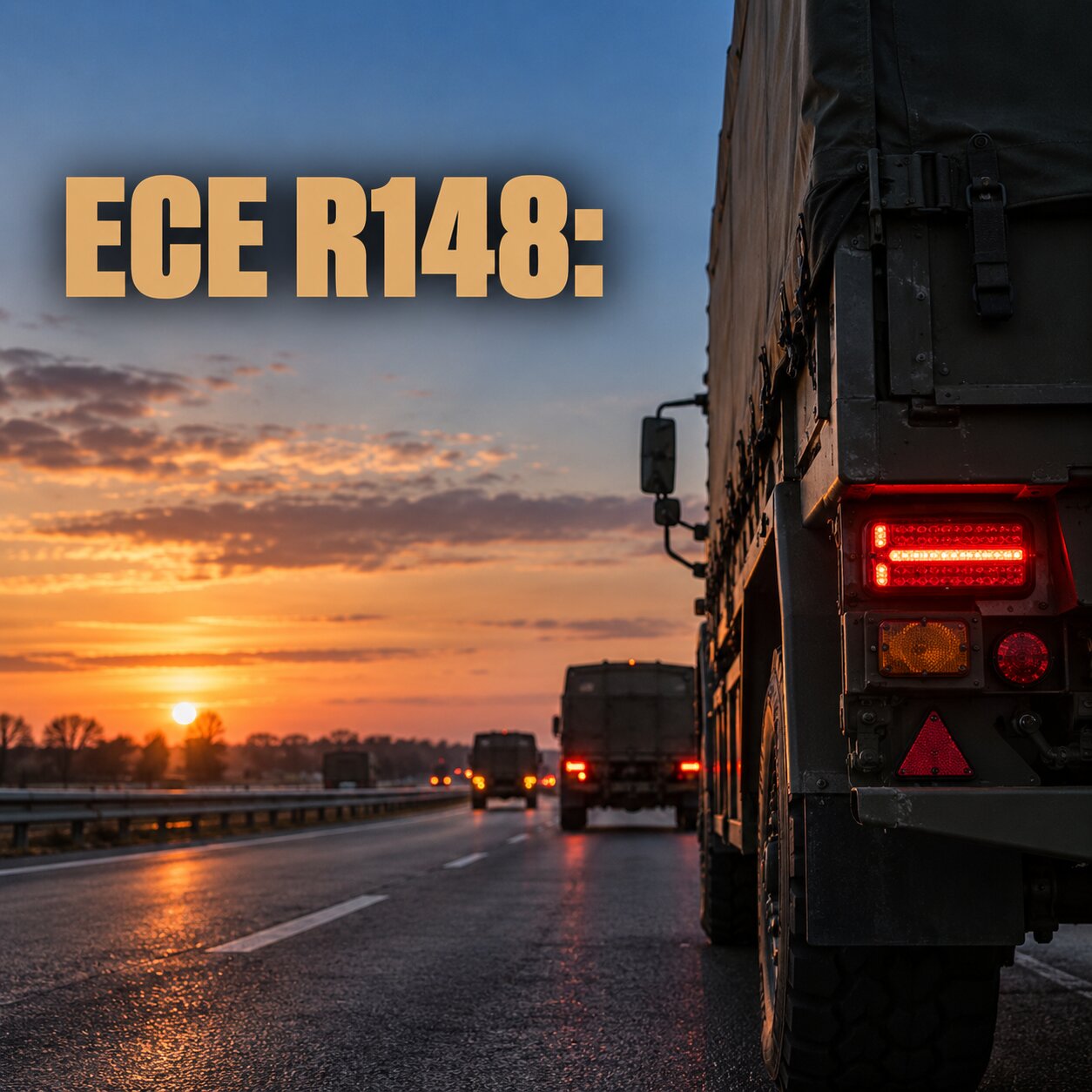
What ECE R148 Covers
The official title is “Uniform provisions concerning the approval of light-signalling devices (lamps) for power-driven vehicles and their trailers”. It is a component regulation: it sets how a lamp must perform to be approved, not where it is fitted on a vehicle.
The scope covers eleven lamp types: rear-registration plate illuminating lamps, direction indicator lamps, position lamps, stop lamps, end-outline marker lamps, reversing lamps, manoeuvring lamps, rear fog lamps, parking lamps, daytime running lamps and side marker lamps.
UN R148 came out of the decision by WP.29, the World Forum for Harmonization of Vehicle Regulations, to simplify the lighting regulations, based on an initial proposal by the European Union and Japan. The stated aim was clarity: fewer regulations, less duplication and a basis for a later move to performance-based requirements. The consolidation was an editorial exercise. It did not change the detailed technical requirements in force at the time, so a lamp did not become brighter, dimmer or a different colour because its regulation changed.
Nine Regulations Became One
Before R148, each lamp function had its own regulation. A rear combination lamp carrying tail, stop, indicator, reversing and fog functions therefore needed approvals under several documents, each with its own amendment history. R148 puts all of them in one text.
The old regulations still matter because existing lamps carry their marks. Our guide to ECE Regulations 6, 7 and 91 explains the requirements for direction indicators, position and stop lamps and side-marker lamps as they were written in those documents.
Lamp Functions and Symbols Under R148
Each approved function is identified on the lamp by a symbol. A lamp that combines several functions shows several symbols in one approval marking. The table maps each function to the regulation that used to govern it and to its R148 symbol.
| Lamp function | Former regulation | R148 symbol |
|---|---|---|
| Front position lamp | R7 | A |
| Rear position lamp | R7 | R1 (steady), R2 (variable intensity) |
| Stop lamp | R7 | S1, S2; S3, S4 for central high-mounted stop lamps |
| End-outline marker lamp | R7 | AM (front), RM1, RM2 (rear) |
| Direction indicator lamp | R6 | 1, 1a, 1b (front); 2a, 2b (rear); 5, 6 (side) |
| Side marker lamp | R91 | SM1 (all vehicle categories), SM2 (M1 only) |
| Reversing lamp | R23 | AR |
| Manoeuvring lamp | R23 | ML |
| Rear fog lamp | R38 | F1 (steady), F2 (variable intensity) |
| Rear-registration plate lamp | R4 | L |
| Parking lamp | R77 | 77R |
| Daytime running lamp | R87 | RL |
| Lamps for category L vehicles | R50 | MA, MR, MS, LM1, 11, 11a, 11b, 11c, 12 |
The split between steady and variable intensity symbols matters on vehicles whose lamps change output, for example in response to ambient light. A lamp marked R1 or S1 has one fixed intensity; R2 or S2 indicates a lamp approved for variable intensity.
What Changed in the Approval Mark
The circled E did not change. It is still followed by the distinguishing number of the country that granted the approval. What changed is how the mark identifies the regulation and its version.
Under the old regulations, the mark did not name the regulation. The function symbol implied it, and the series of amendments was carried in the first two digits of the approval number. Under R148, the marking consists of the circled E, a four to six-digit sequential number placed close to it, the function symbols, and the regulation number followed by the letter R and two digits for the series of amendments: 148R with 00 or 01. With every function in one regulation, the symbols tell you which functions are approved and 148R tells you under which document and series.
R148 also allows the approval marking to be replaced by a Unique Identifier where one is available. A lamp must still carry the manufacturer’s trade name and, where it uses replaceable light sources, their category. Replaceable light sources must themselves be approved under UN R37 or UN R128.
Transitional Provisions and the Old Regulations
Because the consolidation did not change the technical requirements, lamps that already complied did not need re-approval. The nine old regulations were frozen through transitional provisions agreed alongside R148: no further amendments are made to them, and type approvals already granted under them remain valid. New lamp types are approved to R148, and the current 07 series of R48 refers to R148 approval for the lamps it requires.
The 1 September 2026 date is the one to watch in current tenders. A lamp approved to the 00 series before that date is still acceptable. A new approval issued to the 00 series after it may be refused, so new approvals should be to the 01 series. R148 also keeps a route for replacement parts: authorities continue to grant and accept approvals to earlier series for devices intended as replacements on vehicles in use, where the device cannot technically meet the 01 series requirements.
How R148 Relates to R48 and R10
Three regulations are often confused because all three produce an E mark. They answer different questions.
R148 approves the lamp. It covers photometry, colour and the other performance requirements of the device itself, tested on its own.
R48 approves the installation. UN R48 applies to vehicles of categories M, N and O and sets which lamps a vehicle must or may carry, how many, and their position, geometric visibility and electrical connections. Its current 07 series requires signalling lamps such as rear position lamps to be type approved to R148. A compliant lamp mounted in the wrong place, or wired so that it switches with the wrong function, still fails at vehicle level. That is why R148 approval alone does not make a vehicle road legal.
R10 covers electromagnetic compatibility. R148 does not address EMC. UN R10 covers vehicles and the electrical and electronic components and separate technical units fitted to them. An LED lamp with driver electronics can disturb radios and vehicle systems, or be disturbed by them, which is a separate risk from whether it emits the right light. Where EMC evidence is required, it is assessed under R10, not R148.
What R148 Means for Military and Dual-Use Vehicles
A military vehicle that is road registered and driven on public roads needs road functions that a civil authority will accept. For tail, stop, indicator, reversing, fog, marker and plate lamps, that now means R148 approvals. Integrators of dual-use fleets, such as logistics trucks, trailers and protected patrol vehicles that share chassis with civil variants, meet the question most often, because those vehicles move between civil and military regimes.
Practical checks when specifying or accepting lamps:
- Name UN R148 and the series of amendments in the specification, not R6 or R7, unless the lamp is a replacement for an existing approved vehicle.
- Check that the symbols in the marking match every road function the lamp performs on the vehicle, including side and end-outline functions.
- Ask for the approval documentation, not only a photograph of the mark, and confirm which functions it covers.
- Treat EMC evidence under R10 and installation under R48 as separate deliverables.
This applies to LED rear lights and LED signal lights alike, where several approved functions often share one housing.
Blackout, convoy and infrared functions are outside R148. None of them is among the eleven lamp types in its scope, and these functions exist to reduce a vehicle’s visible signature in operations rather than to make it conspicuous to other road users. They are specified under military requirements such as STANAG 4381. Our range of military blackout lights covers that side of the requirement.
Frequently Asked Questions
Not necessarily. Each lamp function has a change index. R148 requires Contracting Parties to keep accepting approvals to earlier series for functions not affected by the latest series, and R48 treats a device approved to an earlier series as equivalent when the change index for each function does not differ. In that case the lamp can be fitted without updating its approval documents or markings. Where it has changed, the 1 September 2026 cut-off described above applies.
An alternative to the conventional approval marking, introduced through the 1958 Agreement. Instead of the circled E, sequential number, symbols and 148R, the lamp shows a UI code. The approval information is then retrieved from the UN secure internet database using that code. It is only used where available, so most lamps in service still carry the full marking.
It depends on how the vehicle is approved and registered. In the EU, Regulation (EU) 2018/858 excludes vehicles designed and constructed or adapted for use by the armed services only, so their lighting falls under national and contract requirements. Vehicles that go through civil type approval or civil registration, including many dual-use and commercially derived platforms, need lamps the approving authority will accept, which in practice means UN R148.
Yes. All three names refer to UN Regulation No. 148. “ECE” and “UNECE” come from the UN Economic Commission for Europe, which hosts WP.29, the forum that adopts the regulations under the 1958 Agreement. Since Revision 3 of that Agreement entered into force on 14 September 2017, the official texts are titled UN Regulations, which is why R148 appears as “UN Regulation No. 148” in the documents while “ECE R148” remains common in specifications and supplier data.