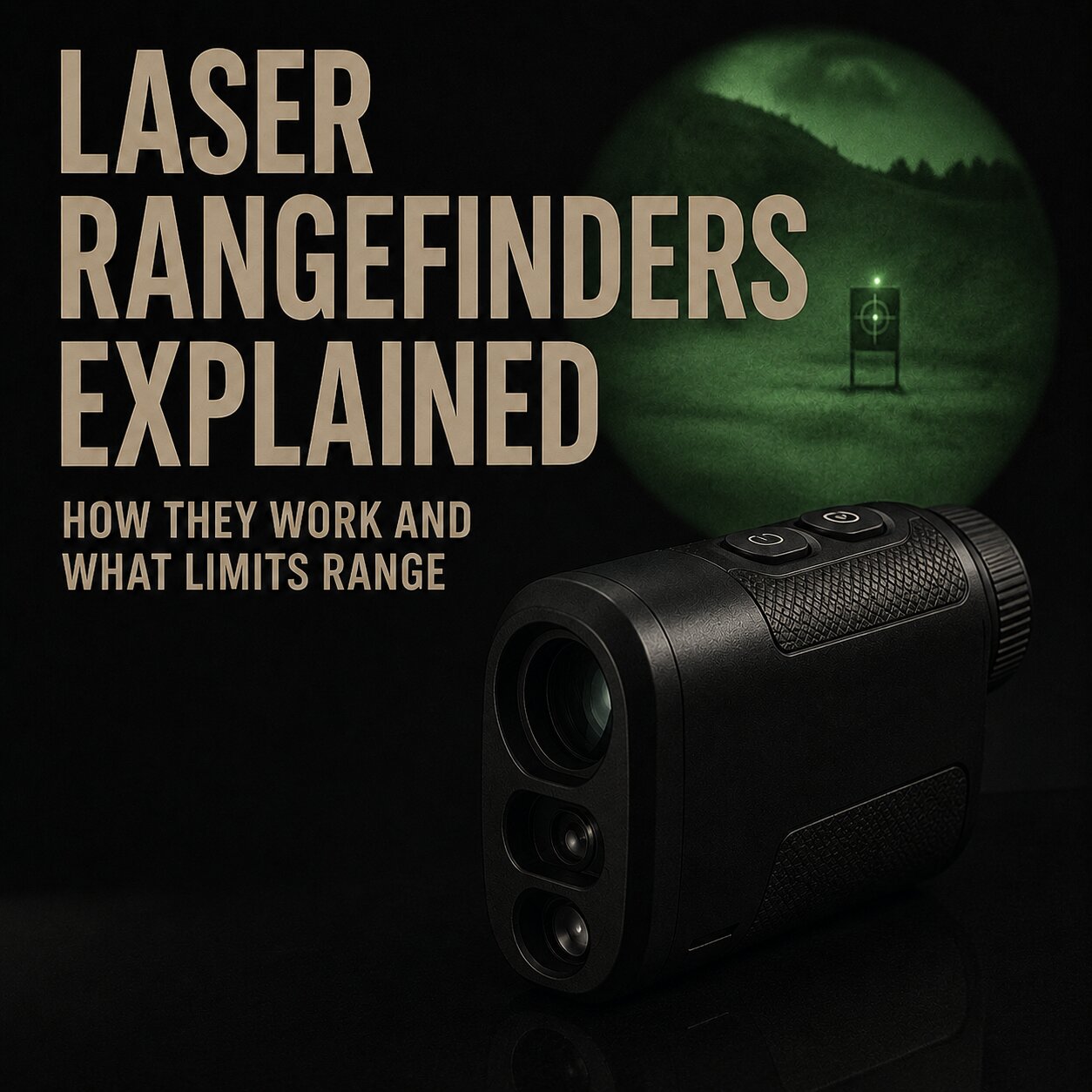
Laser Rangefinders Explained: How They Work and What Limits Range
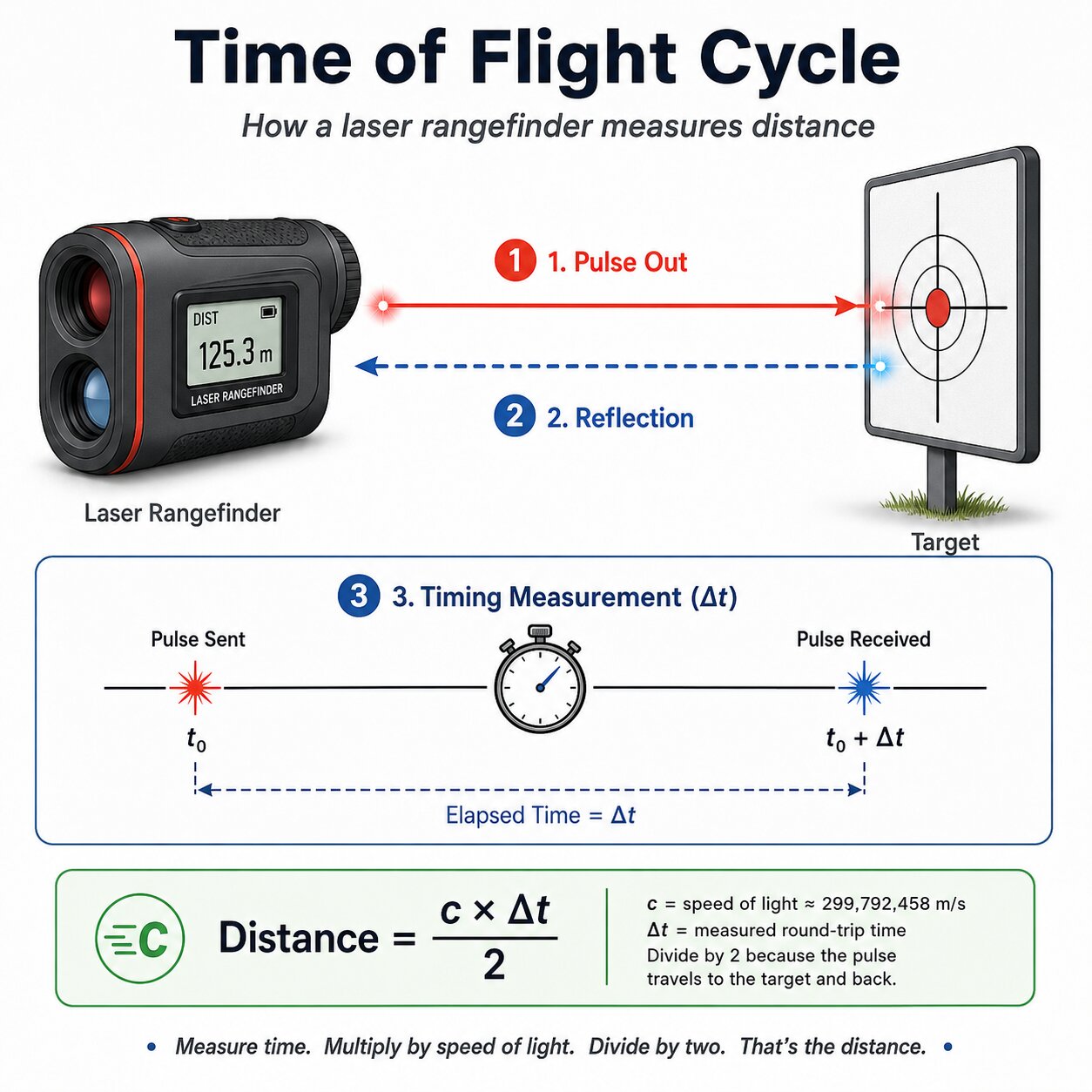
A laser rangefinder measures distance by timing light. It fires a pulse at a target, waits for the reflection to come back, and calculates the range from how long the round trip took.
Simple in principle. The interesting part is what it takes to make that work at four kilometres against a target the size of a vehicle, in daylight, without blinding anyone.
The Time of Flight Principle
The core calculation is straightforward:
Distance = (speed of light × time) ÷ 2
The division by two accounts for the fact that the pulse travels to the target and back, so the measured time covers twice the actual distance.
Light covers roughly 30 centimetres every nanosecond. To measure a range to within one metre, the rangefinder has to time the return pulse to about 6.7 nanoseconds. To hit the sub-metre accuracy quoted on military units, it needs to resolve timing intervals measured in fractions of a billionth of a second.
That timing precision, not the laser itself, is what separates a professional rangefinder from a cheap one.
Why 1550 nm Is Used Instead of 905 nm
This is where the engineering gets genuinely counterintuitive.
Consumer and older rangefinders typically use lasers around 905 nm. That wavelength passes through the eye’s fluid and focuses onto the retina, exactly like visible light. Because retinal damage is the concern, output power has to be kept low to stay eye-safe, and low power means limited range.
At 1550 nm the physics change completely. The cornea and the vitreous humour absorb that wavelength before it can reach the retina. The energy is spread across a much larger area of far less sensitive tissue.
The practical result is that a 1550 nm rangefinder can operate at significantly higher pulse energy while remaining Class 1 eye-safe. More energy means a stronger return signal, which means longer range against poorer targets.
So the eye-safe wavelength is not a compromise made for safety at the cost of performance. It is the reason the performance is possible at all. This is why our QRF-4500 series laser rangefinder uses a 1550 nm Class 1 laser to reach 4,500 metres while remaining safe for use in training environments without additional eye protection.
What Actually Limits Range
Maximum range figures assume favourable conditions. In the field, four factors determine what you will actually get.
Target reflectivity. A pale concrete wall returns far more energy than matte black rubber or wet vegetation. This alone can halve or double effective range.
Target size. The laser beam spreads as it travels. At long range the beam footprint may be several metres across, so a small target only intercepts a fraction of the energy and reflects proportionally less.
Angle of incidence. A surface square to the beam reflects energy straight back. An angled surface deflects most of it away, which is why ranging a sloped roof or an angled vehicle glacis is harder than ranging a flat wall.
Atmosphere. Rain, fog, dust, snow, and heat shimmer all scatter and absorb the pulse in both directions.
First Target and Last Target Modes
Because the beam spreads, it often hits more than one thing. A pulse aimed at a vehicle behind a hedge may return two distinct reflections at different times.
First target mode reports the nearest return. Useful when something is in front of what you want to range, or when you specifically need the range to intervening cover.
Last target mode reports the furthest return. This is the mode for ranging a target through light vegetation or a wire fence, where the intervening clutter produces a weak early return you want the device to ignore.
Knowing which mode is active matters. The same shot at the same target can produce very different numbers.
Why Range Specs Are Hard to Compare
Any manufacturer can quote a large number by measuring against a highly reflective target in perfect conditions. This makes headline range figures close to meaningless for comparison.
Military specifications solve this by defining a standard target. A NATO target is 2.3 by 2.3 metres at 30 percent reflectivity, which approximates a vehicle-sized object with realistic surface properties.
When a rangefinder is quoted at 4,500 metres maximum but 2,000 metres against a NATO target, both numbers are honest. The second one tells you what to expect in the field.
If you are comparing units, compare the NATO target figures. If a manufacturer does not publish one, that is worth noting.
From Distance to Firing Solution
Distance on its own is only part of what a shooter or observer needs.
Modern targeting modules combine the rangefinder with a compass, an inclinometer, and GNSS. From those inputs the device can output the target’s grid coordinates rather than just a distance, which is what makes rapid target handoff to other units or fire support possible.
Add a ballistic computer and the same data produces a firing solution directly, accounting for range, angle, and environmental conditions. Some systems push this data straight to a heads-up display or an external C2 system, removing manual transcription from the loop entirely.
For a look at how these functions integrate in practice, see our night vision and thermal imaging equipment range.
Frequently Asked Questions
Class 1 devices are eye-safe under all normal operating conditions and require no protective equipment. Rangefinders using 1550 nm wavelengths achieve Class 1 classification even at high pulse energies because that wavelength is absorbed before reaching the retina.
Devices using shorter wavelengths such as 905 nm may fall into higher laser classes and carry corresponding handling restrictions.
A rangefinder emits a laser pulse, and laser warning receivers fitted to armoured vehicles and aircraft are specifically designed to detect that emission and alert the crew.
The pulse is invisible to the naked eye and to standard night vision, but it is not undetectable to purpose-built sensors.
Professional units typically specify accuracy better than one metre across their full range. Accuracy is generally consistent regardless of distance because the limiting factor is timing resolution rather than distance itself.
What degrades at long range is not accuracy but reliability of getting a return at all.