

STANAG 2036: Minefield Marking and Recording
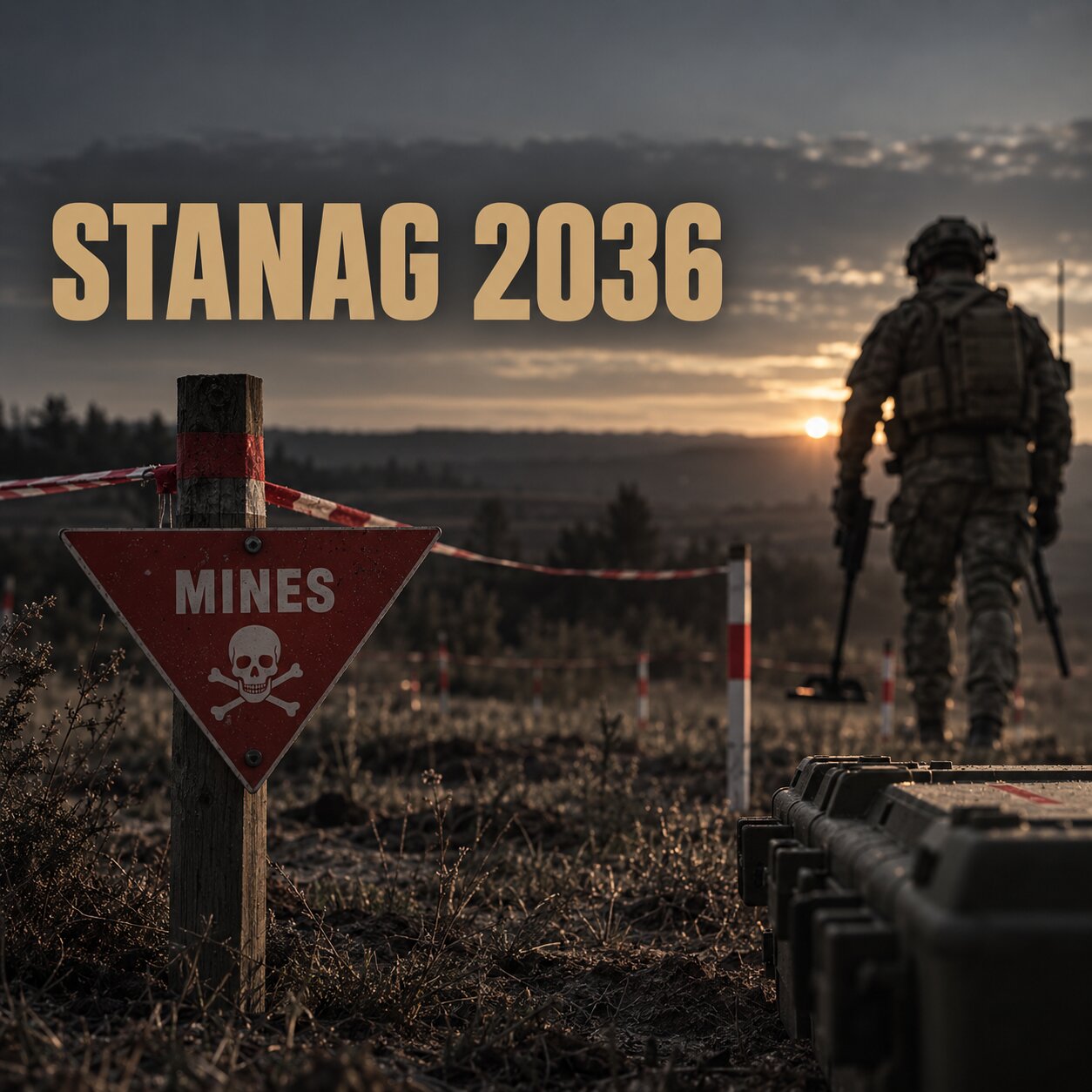
STANAG 2036 is the NATO Standardization Agreement covering land mine laying, marking, recording and reporting procedures. Its stated aim is to standardise how NATO forces plan, lay, mark, record, report and control minefields.
It is a procedural standard rather than a technical one, and that distinction matters for anyone reading it as a buyer rather than an operator.
What the Standard Actually Covers
STANAG 2036 is currently at Edition 5, promulgated 27 January 2005, running to 45 pages. In US service it is implemented through Field Manual 20-32, Mine and Countermine Operations, and it sits alongside allied combat engineer doctrine in ATP-52.
The agreement covers five linked activities.
It is worth being precise about what kind of standard this is. STANAG 2036 governs how a unit conducts an operation. It is not a product specification, so no piece of equipment is “STANAG 2036 compliant” in the way a lamp is compliant with a photometric standard. Any supplier telling you otherwise has misunderstood the document.
What the standard does create is a requirement that has to be met with equipment, and that is where specification comes into it.
Why Marking and Recording Outlive the Operation
Three of the five activities end when the operation does. Two do not.
Marking has to hold for as long as the hazard exists, which may be considerably longer than the unit that laid it remains in the area. Recording exists almost entirely for the future, because the record is what allows the minefield to be cleared later, often years after the conflict ends and by people who were never there.
This is why the standard treats recording with the seriousness it does. An unrecorded minefield does not stop being a minefield. It becomes an unmapped one, and clearance then depends on finding devices rather than reading a document.
The Night Visibility Problem
A perimeter marker that cannot be seen in darkness protects nobody at night, which is when a good deal of movement happens.
This creates a genuinely awkward set of requirements. The marking has to be visible without ambient light, remain visible for an extended and often indefinite period, need no maintenance from a unit that may have moved on, and survive weather, temperature and handling.
Battery-powered markers fail all of that. They have a defined service life measured in weeks or months, they can be switched off or removed, and they require someone to return and replace them. Chemical light sticks are useful for a single night and no longer.
Self-luminous tritium markers behave differently. They produce light through radioluminescence with no power source, no switch and nothing to fail, for well over a decade. That is why they are specified where a marker has to be placed once and then left.
For perimeter and boundary marking, our self-luminous peg lights are driven directly into the ground and require nothing further. For route and defile marking on the approaches, our tritium road markers serve the same function along a track or defile, and our multi-purpose markers cover mounting to existing structures and signage.
Output declines predictably over the life of the source, which matters when a marker may stand for a decade or more. Our guide to tritium service life sets out the decay curve and when a marker stops being readable.
For short-duration marking during the operation itself, chemical light sticks remain the practical choice, though they last a single night rather than a decade.
Related Standards
STANAG 2036 sits within a wider set of marking and warning agreements. STANAG 2002 covers warning signs for the marking of nuclear, biological and chemical contamination, and cross-references 2036 directly. Allied combat engineer doctrine in ATP-52 provides the operational framework both sit inside.
For the tactical use of light as a signalling and marking medium more broadly, see our article on lighting in tactical communication and coordination.
Frequently Asked Questions
Not in any meaningful sense. STANAG 2036 standardises procedures for planning, laying, marking, recording and reporting minefields. It governs how a unit operates rather than how a piece of equipment performs, so it issues no product approvals. Equipment can support compliance with the marking requirement, but that is a different claim from being certified against the standard.
Edition 5, promulgated 27 January 2005, superseding earlier editions dating back to 1987. It runs to 45 pages and remains current. In US service it is implemented through FM 20-32, Mine and Countermine Operations.
Because clearance happens later, often long after the conflict and carried out by people who were not present when the minefield was laid. The record is what makes systematic clearance possible. Without it, deminers are searching rather than following a map, which is slower, more dangerous and less complete. An unrecorded minefield does not stop being a minefield; it becomes an unmapped one.