STANAG 4694: The NATO Accessory Rail Explained
STANAG 4694 defines the NATO Accessory Rail, the interface used to mount optics, tactical lights, laser modules, night vision devices, foregrips and bipods to NATO small arms.
It is often described as the metric version of the Picatinny rail, which is true but incomplete. The dimensions are broadly the same. What changed is how tightly they must be held, and that is the part that matters when you are mounting something that has to return to zero.
What STANAG 4694 Actually Changed
The NATO Army Armaments Group approved STANAG 4694 in 2009 through Land Capability Group 1, and it was published in March 2011. It was developed alongside Aimpoint, Beretta, Colt, FN Herstal and Heckler & Koch, which is worth noting because it means the standard was written with the accessory manufacturers in the room rather than imposed on them afterwards.
NAAG lists four differences from MIL-STD-1913:
- A metric reference drawing rather than imperial dimensions
- Additional new measurements and tolerances
- Adjustments to some existing measurements
- Straightness tolerances reduced by approximately 50 percent
Three of those are housekeeping. The fourth is the reason the standard exists.
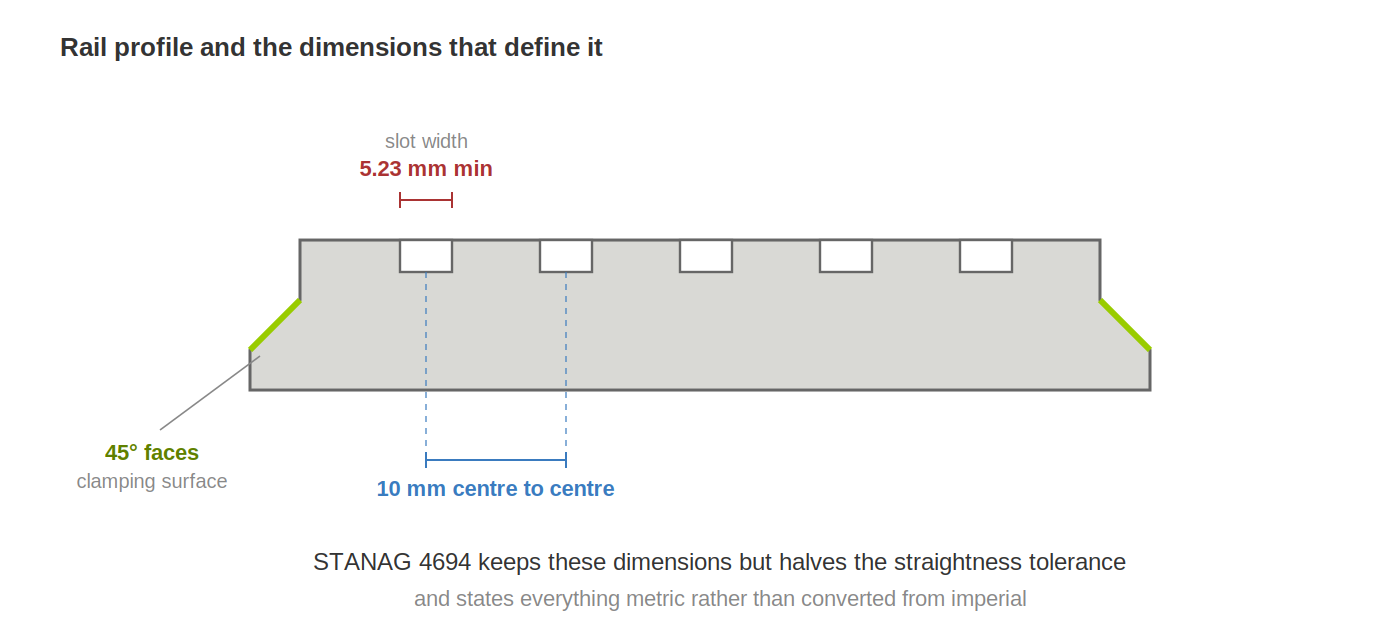
The rail profile is common to both standards. STANAG 4694 restates it in metric and halves the permitted deviation from straight.
Why Straightness Tolerance Decides Return to Zero
A rail is not a single mounting point. It is a series of them, and an accessory clamps across several slots at once.
If the rail bows even slightly along its length, the clamping faces are no longer in one plane. The accessory seats against whichever points contact first, and which points those are can change every time it is refitted. The result is that a scope or clip-on device removed and replaced does not necessarily return to the same point of aim.
For a foregrip this is irrelevant. For a laser module, a clip-on thermal sight or a night vision device sitting in front of a day optic, it is the whole question. Halving the straightness tolerance halves the worst-case deviation the accessory has to sit across, which is why the change was made.
This is also why our TI-GEAR-C clip-on thermal sight is specified as requiring no re-zeroing. That claim depends on the rail underneath it being held to standard, which is not something to assume.
The “So-Called Picatinny” Problem
A significant number of rails sold as Picatinny do not meet MIL-STD-1913, let alone STANAG 4694.
The two dimensions that give it away are the recoil slot width, which should be a minimum of 5.23 mm with a square bottom, and the slot spacing, which should be 10 mm centre to centre. Rails that miss these will still accept most accessories, because clamps have enough travel to grip almost anything. What they will not do is position that accessory consistently.
The failure mode is quiet. Nothing falls off, nothing looks wrong, and the shooter simply finds that zero drifts between mount and remount without an obvious cause. For procurement, the practical measure is to require the standard by name in the specification and to verify the slot geometry on receipt rather than trusting the product description.
Backwards Compatibility and What It Does Not Guarantee
STANAG 4694 is backwards compatible with MIL-STD-1913, also catalogued as STANAG 2324. In practice this means existing Picatinny accessories mount to a NAR rail and NAR accessories mount to a Picatinny rail. Nothing in an inventory becomes obsolete.
What compatibility does not do is transfer the precision benefit. The tighter tolerance only helps if both halves of the interface are held to it. A NAR-specification mount on a loosely manufactured commercial rail inherits the rail’s error, and the reverse is equally true.
If return to zero matters for the application, the rail and the mount both need to be specified, not just the accessory.
| MIL-STD-1913 | STANAG 4694 | |
|---|---|---|
| Also known as | Picatinny, STANAG 2324 | NATO Accessory Rail, NAR |
| Published | February 1995 | March 2011 |
| Units | Imperial | Metric |
| Straightness tolerance | Baseline | Approximately 50% tighter |
| Cross compatibility | Accepts NAR accessories | Accepts Picatinny accessories |
Mounting Lights, Lasers and Optics
For weapon-mounted lighting the rail interface determines three things: whether the beam stays aligned with the bore, whether the device survives recoil without shifting, and whether it can be removed and refitted without recalibration.
Our B120 LEP weapon light and B20 green and infrared laser pointer both mount to NAR and Picatinny rails. For thermal and night vision devices where zero retention is critical, see our night vision and thermal imaging range, including the TI-GEAR-S thermal weapon sight.
Frequently Asked Questions
Not quite. The profile and slot geometry are essentially the same, and the two are cross compatible, so accessories mount to either. STANAG 4694 restates the dimensions in metric, adds measurements and tolerances that MIL-STD-1913 did not specify, and tightens the straightness tolerance by roughly half. The difference is manufacturing precision rather than shape.
Yes. STANAG 4694 was written to be backwards compatible with MIL-STD-1913, so existing accessories mount without modification. The tighter tolerance improves how consistently an accessory positions itself, but that benefit only applies where both the rail and the mount are manufactured to the standard.
Check the recoil slots. They should measure at least 5.23 mm wide with a square bottom, spaced 10 mm centre to centre. Rails that miss these dimensions will still accept accessories, since clamps have enough travel to grip almost anything, but they will not position them repeatably. Specify the standard by name in procurement and verify the geometry on receipt.