

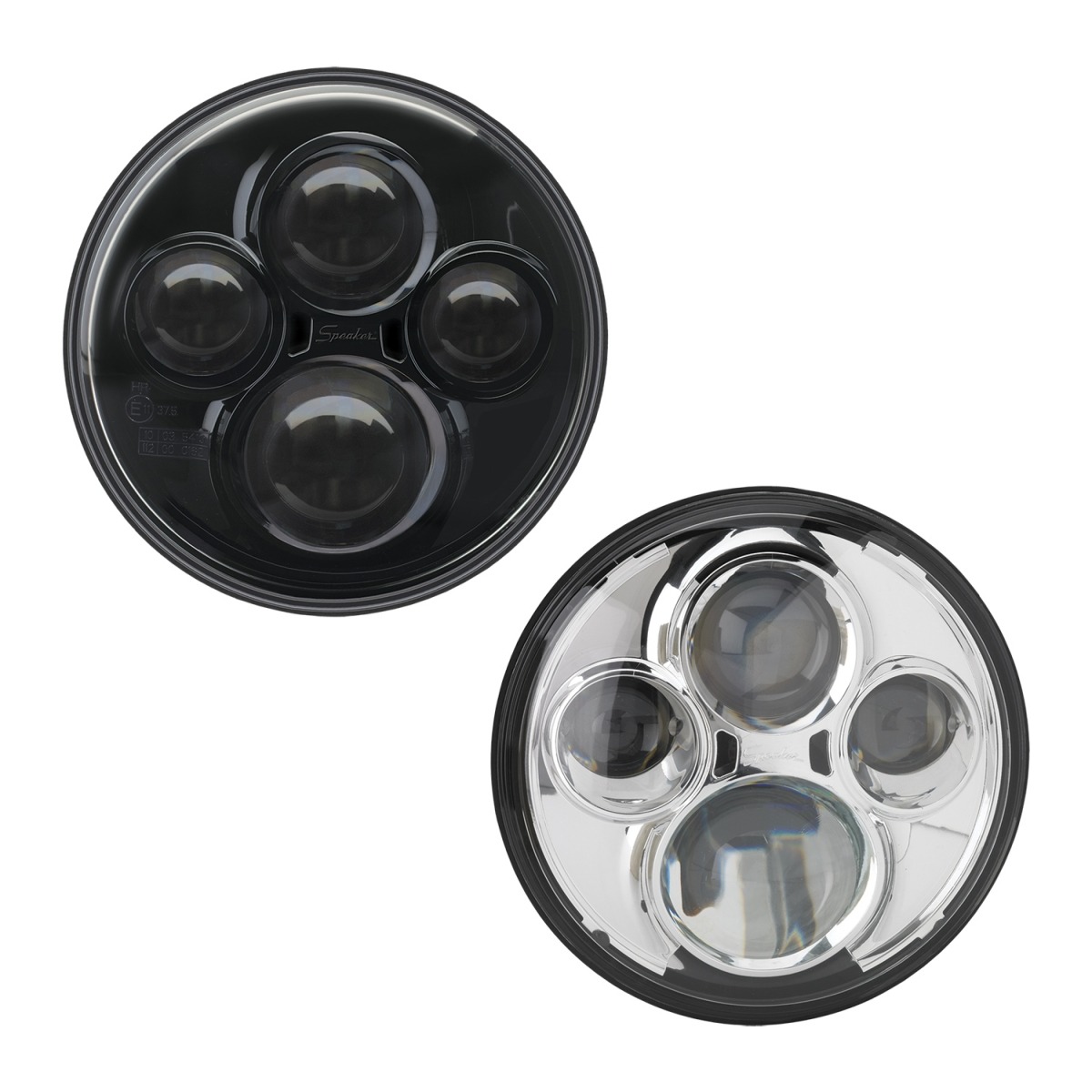
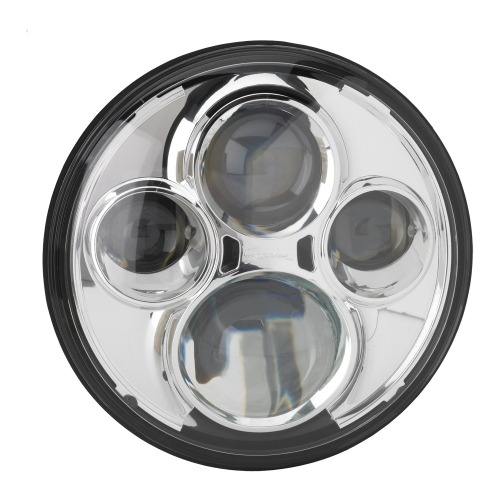
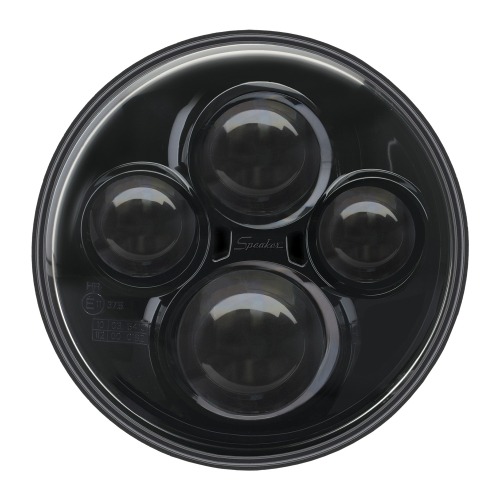

Features
- Dedicated driving beam: a high beam only optic puts the light far down the road, with no passing beam cut-off to compromise the pattern.
- Long-range view on unlit routes: a concentrated beam shows obstacles and road edges earlier on unlit roads and tracks.
- Retrofit without bodywork changes: fits the 7-inch round headlamp format, as a replacement high beam unit or as an extra driving lamp in a mounting ring.
- Plugs into a standard headlamp harness: the existing headlamp wiring can usually stay, which keeps fleet retrofits quick.
- No filament to fail: solid-state LED construction, with no filament to break under shock and vibration and no bulb to replace in service.
- Full output at switch-on: the LEDs reach full intensity immediately, which suits intermittent high beam use and flashing.
- Published photometric data: raw and effective lumen figures and an isolux chart let engineers compare the beam with other lamps before ordering.
What is an LED auxiliary driving light?
An auxiliary driving light is an additional main beam lamp. UN Regulation No. 48 defines the driving beam (main beam) headlamp as the lamp used to illuminate the road over a long distance ahead of the vehicle. Model 8710 is a 7-inch round (PAR56) LED lamp with a high beam only pattern, used together with the vehicle’s dipped beam headlamps.
Because it has no low beam, Model 8710 does not replace a combined headlamp. It takes the place of a separate high beam unit, or it is mounted as an extra pair of driving lamps on a bumper, grille guard or bracket. Where the vehicle needs a 7-inch lamp with both beams, pair it with our military headlight.
Effective Lumen Isolux Chart
An isolux chart plots lines of equal illuminance on the road ahead of the lamp, so it shows how far and how wide the beam reaches. It is drawn from the effective output, the light that actually leaves the lens. Our article on raw lumens vs effective lumens explains the difference.

Output of the LEDs themselves, before the lens, reflector and heat take their share
Light that leaves the lamp and reaches the road, about 44% of the raw figure
Intensity on the beam axis; by the inverse square law, about 1 lux at roughly 365 m
Part Numbers and Accessories
| Part No. | Description |
|---|---|
| 0550021 | LED Auxiliary Driving Light, Model 8710, PAR56, High beam |
| 055556 | NSN: 6620-01-672-5766 |
| 3156351 | Mounting Ring Kit for 8710 |
| 3266081 | Jumper Harness H4/H13 for 8710 |
State the part number, the bezel colour and the quantity in your enquiry. Add the mounting ring kit where the lamp is fitted in a 7-inch round aperture, and the jumper harness where the vehicle’s headlamp plug is not H4.
Specifications
| Description | Model 8710 LED Auxiliary Driving Light |
| Lumen Output | Raw: 3,300; Effective: 1,440 |
| Candela Output | 133,000 |
| LED Color | 4750K |
| Input Voltage | 12V to 24V DC |
| Current Draw | 4.80A @ 12V; 2.50A @ 24V DC |
| Operation Temperature | -40°C to 65°C |
| Lens Material | Polycarbonate |
| Housing Material | Aluminum |
| Housing Color | Black |
| Bezel Color | Black or Chrome |
| Mounting Type | PAR56″ / 7″ round headlights |
| Connector | H4 |
| Matching Connector | AMP# 172615-2 |
| Standards | Sealed to IP 67; ECE Reg. 112 & 10 |

Long-Range Light for Military and Fleet Vehicles
Military, specialist and fleet vehicles often travel at night on roads and tracks with no street lighting, where the dipped beam alone shows too little of the route ahead. Reach depends on how strongly the light is concentrated along the beam axis, which is what the candela figure measures; total lumens describe the quantity of light, not how far it carries. Our guide to lux vs lumens explains how the units relate.
The lamp is built for the same conditions as the rest of the vehicle. IP67 under IEC 60529 means dust-tight and protected against temporary immersion, which matters for a lamp low on the front of a vehicle that drives through mud, spray and washdown. ECE Regulation No. 10 sets electromagnetic compatibility requirements for vehicles and their electronic sub-assemblies, including control of unwanted emissions that could disturb radios and other electronics on board. Model 8710 is a service lamp: under light discipline it stays off with the rest of the service lighting and the crew drives on the vehicle’s military blackout lights.

Frequently Asked Questions
Under UN Regulation No. 48, which governs lamp installation on vehicles approved to ECE rules, the aggregate maximum intensity of all main beam headlamps that can be switched on at the same time must not exceed 430,000 cd, a reference value of 100. Every driving beam headlamp approved under ECE Regulation No. 112 carries a reference mark for its maximum intensity. Add the marks of the vehicle’s own main beams and the auxiliary driving lights that light with them, and keep the total at or below 100.
No DOT, SAE or FMVSS 108 marking is listed for this lamp. Its listed approvals are ECE Regulations 112 (headlamps emitting an asymmetrical passing beam, a driving beam or both) and 10 (electromagnetic compatibility). If the vehicle must meet FMVSS 108, raise this at the enquiry stage so we can advise on a suitable lamp.
No. It is a visible white lamp, and bright visible light causes glare and blooming in image intensifier night vision devices and washes out the image. When the crew drives on night vision, the service lights stay off and the ground ahead is lit in the near infrared instead, for example with our IR driving lights.
