

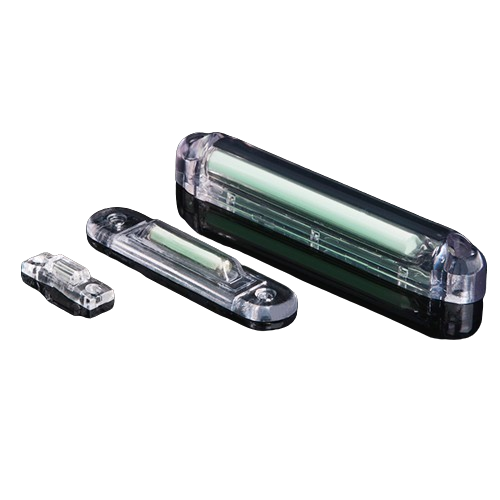


Features
- Always on, without power: the marker glows from the moment it is fitted, day and night, with no switch, battery or wiring, and keeps working when the power fails.
- Fit and forget: no battery changes, bulb replacements or charging during the service life, which suits remote and unmanned sites.
- No light needed to charge: unlike photoluminescent markings, the glow does not depend on prior exposure to light, so it still shows in a shelter, hold or store that has been dark for days.
- Marks without lighting up the area: a low-level glow lets personnel find routes, hazards and equipment without switching on a torch or room light.
- Colour coding: different colours let one site separate routes, hazards and equipment at a glance.
- Line, dome and flat top formats: four models cover elongated, large round and compact marking positions.
- No electrical signature: there is no circuit, so the marker emits no electromagnetic interference and cannot disturb radios, sensors or avionics.
What are multi-purpose tritium markers?
Multi-purpose tritium markers are small self-luminous markers that are fixed to routes, hazards and equipment so they can be found and identified in darkness. Each marker holds a gaseous tritium light source: a sealed glass capsule, coated inside with phosphor and filled with tritium gas. The tritium emits low-energy beta particles that make the phosphor glow continuously, so no external energy is needed. They belong to the same family as our other tritium lights. For marking routes, bridges and minefield lanes in the open, the larger tritium road markers attach to poles, trees or wires.
This is different from glow in the dark tape and signs, which are photoluminescent: they store light and release it after the lights go out, so they must be charged by ambient light first. A tritium marker needs no charging. Its brightness falls slowly as the tritium decays, with a half-life of about 12.3 years, and the tritium fill is calculated so the marker stays above its minimum brightness for the specified 10 to 15 years.
Specifications
| Brightness Levels | 80 µL to 900 µL |
| Operating Temperature Range | -60°C to +80°C |
| Operational Life | 10 to 15 years |
| Power Source | None (no batteries or bulbs required) |
| Waterproof | Yes |
| EMC Compliance | MIL-STD-464 |
| Maintenance | Maintenance-free |
| Material | Tough, impact-resistant yet lightweight enclosures |
Models and Dimensions
| Product | Width | Height | Length | Diameter |
|---|---|---|---|---|
| LINE (SURFACE) MP 166 | 12.7 mm | 14.2 mm | 95.3 mm | N/A |
| LINE (SURFACE) MP 145 | 15.5 mm | 8.0 mm | 65.5 mm | N/A |
| DOME (SURFACE) MP 152 | N/A | 33.3 mm | N/A | 66.8 mm |
| FLAT TOP (SURFACE) MP 107 | N/A | 25.4 mm | N/A | 28.6 mm |

Marking That Survives a Power Failure
In a shelter, on a ship or in an aircraft, the moment the lights go out is when people most need to find the exit, the switch or the alarm button. A self-luminous marker has no battery or wiring, so it is already lit when the power fails. In the field, ropes, steps, tents and portable kit stay marked all night without spending batteries.
Plan replacement around brightness, not failure: the marker dims gradually as the tritium decays, as explained in how long tritium lasts. At the end of its life, return it to the supplier or dispose of it under the local rules for radioactive materials (see tritium safety).
Frequently Asked Questions
Each marker contains a sealed glass capsule coated inside with phosphor and filled with tritium gas. Tritium emits low-energy beta particles, which make the phosphor glow. The process runs continuously and needs no battery, wiring or exposure to light. The beta particles travel only a few millimetres in air and cannot penetrate the skin.
Four surface models are listed: the MP 166 and MP 145 line markers, the MP 152 dome marker and the MP 107 flat top marker. Their dimensions are in the Models and Dimensions table above. Each is available in a range of brightness levels and colours.
Brightness is given in microlamberts (µL), a unit of luminance. One microlambert is about 0.0032 cd/m², so the range runs from about 0.25 cd/m² to about 2.9 cd/m². That is enough to locate and identify a marked object in darkness, not to light up its surroundings. Colour also matters: with the same tritium fill, a green marker appears brighter than a red or blue one.
Yes. The markers are waterproof and continue to operate under water. They work from -60°C to +80°C, because the light comes from radioactive decay rather than a battery, whose capacity drops in the cold.
Yes. The markers are available in different sizes, shapes and colours, so a site can use colour to separate routes, hazards and equipment. Contact us with the application, the colour and the brightness level you need.
Do not open or break a marker. If the glass capsule inside is intact there is no exposure risk. Do not put markers in ordinary waste: return them to the supplier or dispose of them under the local regulations for radioactive materials.