



Features
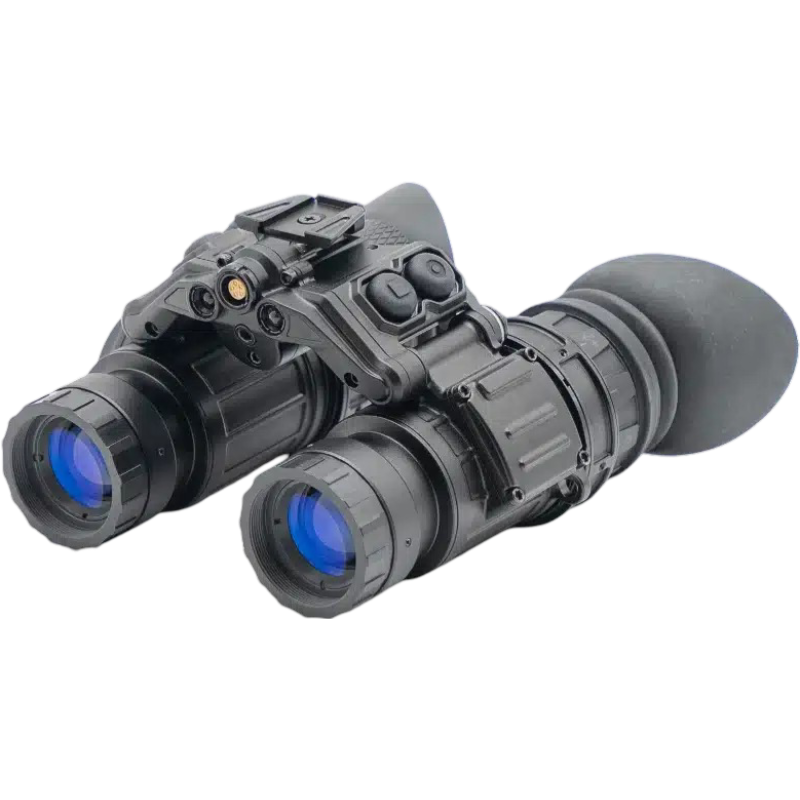
- Two Tubes, Two Eyes: each eye looks through its own image tube, so the PVS-31C-4B gives the depth perception that a single-tube monocular cannot.
- Instant IR for Close Work: the built-in IR illuminator switches on at once for map reading in zero light and can key Morse code to other goggle users.
- Selective Channel Engagement: on the GR8 mount, flipping one tube up switches that channel off and leaves one eye unaided.
- Flip-Up Off and Stow Safety: the goggle switches off when flipped up or stowed and on again when lowered, saving the battery without a hand on the switch.
- Push-Button Controls: the controls are designed for use with gloves, so users adjust the goggle in the dark without taking it off.
- A Tube to Suit the Task: specify Gen 2+ up to Photonis 5G, green or white phosphor, autogated or manual gain, to match the budget and the darkness of the work.
What Are Dual-Tube Night Vision Goggles?
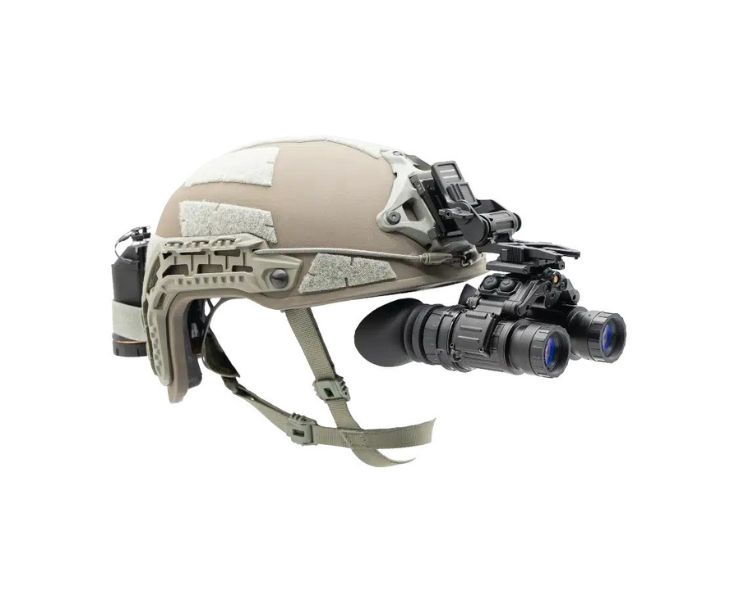
Military night vision goggles are worn on the helmet in front of both eyes, so the user keeps both hands free for a weapon, a vehicle or a task. In dual-tube night vision each eye has its own image tube, while a monocular gives one eye a tube and leaves the other unaided.
The PVS-31C-4B is a dual-tube military NVG from GSCI Advanced Photonics, built in Ontario, Canada. It mounts on the helmet or works in the hand, and it is supplied with the tube the buyer specifies from the list on this page.
White Phosphor Night Vision Technology
The PVS-31C-4B is specified with white phosphor, which shows the scene in shades of grey instead of green. Many users find this image more natural and less tiring over a long night, and white phosphor is increasingly preferred by military users.
Exosens, the maker of Photonis tubes, reports no laboratory performance difference between white (P45) and green (P43) phosphor, and its soldier trials found no difference in combat effectiveness. Comfort decides, so every tube on the list below is offered in green or white.

Available Tubes
Each option is listed with its figure of merit (FOM), the tube resolution multiplied by its signal-to-noise ratio. A higher FOM gives a cleaner image in darker conditions.
- Gen 2+ Up to 1250 FOM Green or White Autogated
- Gen 2+ 1251-1599 FOM Green or White Autogated
- Photonis ECHO 1600-2000 FOM Green or White Autogated & Manual Gain
- Photonis ECHO 2000+ FOM Green or White Autogated & Manual Gain
- Photonis 4G 2300+ FOM Green or White Autogated & Manual Gain
- NEW: Photonis 5G 2500+ FOM Green or White Autogated & Manual Gain
Accessories
- GR8™: Advanced NVG Helmet Mount
- MVP-240: Multi-Voltage Battery Pack
- TICON: Thermal Clip-On Attachment
- HMH-1: Helmet Mounting Harness
- NVR-714D: Digital Recorder
- MTAR-HUD: Heads-Up Display
Specifications
| Configuration | Dual-tube binocular |
| Image Tube | White phosphor |
| IR Illuminator | Instant IR with Morse code function |
| Battery Type | AA or CR123 |
| Power Extension | External battery port |
| Drop Resistance | Tested to 2-meter drop |
| Compression | Vehicle compression tested |
| Mounting | Helmet-mountable, handheld capable |
| Warranty | 7 years |
| ITAR Status | ITAR-free, no import/export licence required |
| Fusion Upgrade | Available |
| Maintenance | Local maintenance support available |
The PVS-31C-4B Restores Depth Perception for Night Movement
With a tube in front of each eye, PVS-31C-4B users judge distance on broken ground, stairs and vehicle steps more easily than with one tube. Army binocular night vision programmes give the same reason for moving from monocular to two-tube designs.
The housing is tested to a 2-metre drop and to vehicle compression, the knocks a helmet-mounted goggle takes in vehicles and on foot. AA or CR123 cells and the external battery port let a unit run it on the batteries it already stocks, or on the MVP-240 pack.
GSCI states that the PVS-31C-4B is ITAR-free, so no US re-export approval applies. European and national export and end-user rules still apply, so name the end user and destination country in your quotation request.
Matching IR Lights
The PVS-31C-4B amplifies light that is already there. Indoors, under cover or on an overcast night there may be too little, and an infrared light supplies it without any visible glow to the naked eye.
IR light is invisible to the naked eye but not to other night vision users, so treat every IR source as visible to an opponent wearing goggles. Use the built-in instant IR for close work and a dedicated IR light for range.
For vehicles carrying goggle users, a vehicle-mounted infrared light does this job at range, without crews having to use their own instant IR.

Frequently Asked Questions
The tube sets most of the PVS-31C-4B’s performance and price. Tubes in the 1,800 to 2,200 FOM range perform very capably for most professional work, while the Photonis 5G at 2500+ is aimed at units working regularly in the darkest conditions. Choose manual gain if users want to turn the image down in streetlit or mixed light.
Pricing is on request because it depends mostly on the tube: its FOM band, green or white phosphor, and autogated or manual gain. Add the mount, battery pack and any fusion upgrade, then use Add to Quotation with the quantity, end user and destination country so we can confirm price, availability and export paperwork.
Yes. A fusion upgrade adds thermal imaging to the PVS-31C-4B and displays the thermal overlay within the night vision image, so heat sources stand out from their surroundings. Tell us whether you need the upgrade with the first order or later, and we will confirm the compatible thermal module.