

Why Are My Headlights So Dim? 6 Causes, Fixes & Prevention
Dim headlights are more than an inconvenience. At night or in poor weather, headlights that are not bright enough directly reduce your reaction time and your visibility to other road users. In many countries, headlights that fall below a minimum brightness threshold are also illegal and will cause a vehicle to fail its roadworthiness inspection.
The good news is that dim headlights almost always have a specific, identifiable cause. This guide covers the six most common reasons headlights become too dim, how to diagnose which one applies to your vehicle, and how to fix it properly.
Why Are Headlights Not Bright Enough?
Headlights dim for two broad reasons: the light source itself is degrading, or something in the electrical system is reducing the power reaching the bulb. Both produce the same symptom but require different fixes, which is why identifying the root cause before replacing parts saves time and money.
The type of bulb fitted also matters. Halogen bulbs lose brightness gradually over their lifespan and will appear noticeably dimmer after 500 to 1,000 hours of use even before they fail completely. LED headlights degrade far more slowly but can still appear dim if the electrical system supplying them is not functioning correctly.
How to Diagnose Dim Headlights Quickly
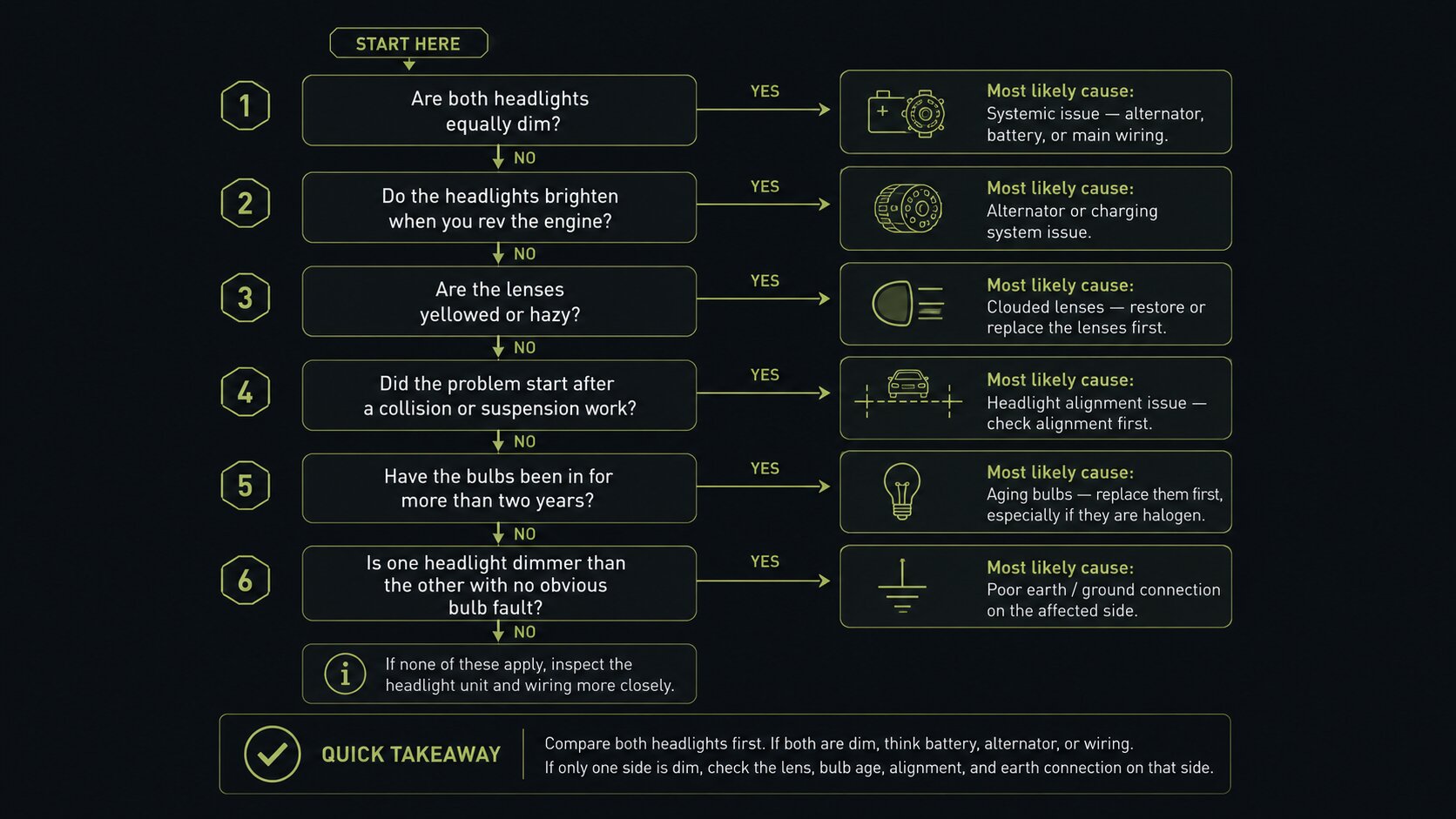
The 6 Most Common Causes of Dim Headlights
1. Ageing or Failing Bulbs
Halogen headlight bulbs lose brightness as the tungsten filament degrades over time. Unlike LED bulbs, which maintain consistent output until close to the end of their lifespan, halogen bulbs dim gradually. Most drivers do not notice the change because it happens slowly, but by the time a halogen bulb is 2 to 3 years old it can be producing significantly less light than when new.
This is the most common cause of headlights that are not bright enough on older vehicles, and the simplest to fix.
How to fix it:
- Replace halogen bulbs in pairs so both headlights deliver the same output
- Consider upgrading to LED headlights, which deliver more light, use less power, and maintain consistent brightness throughout their lifespan
- If you have already replaced bulbs and the headlights are still dim, the cause is elsewhere in the system
2. Cloudy or Yellowed Headlight Lenses
Plastic headlight lenses yellow and haze over time due to UV exposure, road debris, and oxidation. Even a moderately hazed lens can reduce light output by 50 percent or more, making bright bulbs appear dim regardless of their actual output. This is one of the most common causes of dim headlights on vehicles that are more than five years old.
How to fix it:
- Inspect the lenses in daylight. A lens that looks yellow, milky, or scratched from outside is reducing light output significantly
- Headlight restoration kits using wet sandpaper and UV-resistant coating can restore moderate hazing
- Severely damaged lenses should be replaced entirely rather than restored, as the improvement from restoration is temporary on heavily oxidised plastic
- When replacing lenses, ensure the replacement is correctly sealed to prevent moisture ingress
3. Corroded or Poor Earth Connections
The earth connection for your headlight circuit is typically connected to a metal point on the vehicle’s bodywork or chassis. Over time, this connection corrodes, and the resulting resistance reduces the current reaching the headlight. This is one of the most frequently overlooked causes of dim headlights, particularly on older vehicles and working vehicles exposed to moisture, salt, and mud.
A poor earth connection often produces a specific symptom: headlights that flicker slightly or vary in brightness when the vehicle goes over bumps, or one headlight that is noticeably dimmer than the other without any obvious bulb fault.
How to fix it:
- Locate the earth connection for the headlight circuit, usually a bolt attaching a wiring loom to bare metal near the headlight assembly
- Remove the bolt, clean the contact surface with sandpaper or a wire brush, and reattach securely
- Apply a small amount of electrical contact grease to prevent future corrosion
- If the problem returns quickly, the earth point itself may be corroded beyond cleaning and the connection should be relocated to a clean section of metal
4. Weak or Failing Alternator
The alternator charges the battery and powers the vehicle’s electrical systems while the engine is running. When an alternator is weakening, it cannot maintain the correct output voltage, and every electrical system on the vehicle, including the headlights, receives less power than it needs.
The clearest sign of an alternator-related dim headlight problem is brightness that changes with engine speed. Headlights that brighten noticeably when you rev the engine and dim again at idle are almost always pointing to a charging system issue rather than a bulb or wiring fault.
How to fix it:
- Have the alternator output tested. A healthy alternator should produce between 13.8V and 14.4V with the engine running on a 12V system, or 27.6V to 28.8V on a 24V vehicle system
- A battery in poor condition can also cause similar symptoms. Test both at the same time
- If the alternator output is within range but the headlights still dim at idle, check for excessive electrical load from other accessories on the same circuit
- Alternator replacement is a job for a qualified mechanic on most modern vehicles
5. Damaged or Corroded Wiring
Wiring that has aged, chafed against bodywork, or been exposed to heat can develop high resistance without failing completely. This resistance reduces the current reaching the headlight, producing the same dimming effect as a failing alternator but isolated to the headlight circuit. Corrosion inside headlight connectors is particularly common on vehicles that operate in harsh environments.
On fleet vehicles and military platforms, wiring degradation is a routine maintenance issue rather than an unusual fault. Regular inspection of headlight connectors and wiring looms is standard practice for any vehicle operated in demanding conditions.
How to fix it:
- Inspect the wiring and connectors at the headlight assembly for signs of corrosion, heat damage, or physical wear
- Corroded connectors should be cleaned with electrical contact cleaner and treated with dielectric grease
- Wiring that has worn through its insulation should be repaired or replaced rather than taped over
- If only one headlight is dim, start at the connector for that headlight before investigating the wider circuit
6. Misaligned Headlights
Headlights that are aimed too low or pointing in the wrong direction do not produce less light, but they project it in a way that reduces effective road illumination significantly. A headlight aimed at the road surface five metres in front of the vehicle provides a fraction of the visibility of a correctly aimed beam. Many drivers mistake poor alignment for dim output because the practical effect on visibility is the same.
Headlight alignment can shift gradually over time from vibration and road impacts, or suddenly after a collision or suspension repair.
How to fix it:
- Headlight alignment can be checked at home against a wall using the marks in your vehicle’s manual, or measured precisely at a garage with a beam setter
- Most headlight assemblies have adjustment screws that allow vertical and horizontal alignment to be corrected without specialist tools
- After any suspension work, collision repair, or headlight replacement, alignment should be checked as a matter of course
Halogen vs LED: Does the Bulb Type Affect Brightness?
Yes, significantly. Halogen bulbs are the standard fitment on most vehicles but are the least efficient option available. A typical halogen headlight converts only about 10 percent of the energy it uses into visible light, with the remainder lost as heat. They also dim progressively as the filament degrades.
LED headlights produce more usable light per watt, maintain consistent brightness throughout their lifespan, and do not suffer from the gradual dimming that makes ageing halogen bulbs such a common cause of poor headlight performance. Upgrading from halogen to LED is one of the most effective ways to improve headlight brightness without changing anything else in the vehicle’s electrical system.
Our LED headlights for trucks and military vehicles are built to deliver consistent output across a wide voltage range, making them suitable for both standard 12V vehicles and 24V military and fleet platforms. If you are looking for a sealed beam replacement, our LED sealed beam headlights are a direct upgrade option for vehicles that use this format.
Preventing Dim Headlights Long-Term
- Replace halogen bulbs in pairs every two to three years before they dim noticeably rather than waiting for failure
- Inspect and clean headlight lenses annually, particularly on vehicles parked outside. UV protective coatings slow oxidation significantly
- Check earth connections during routine servicing, especially on vehicles operating in wet or salty environments
- Have the charging system tested if headlights begin dimming with engine speed changes
- Check alignment after any suspension or headlight work to ensure output is directed where it is needed
When only one headlight is dim, the fault is almost always localised to that side. Check the bulb, the connector, and the earth connection on the affected side. If the bulb is new and the connector is clean, a poor earth is the most likely cause.
In most jurisdictions, yes. Headlights must meet a minimum brightness standard and be correctly aligned. Vehicles with headlights below the legal threshold can fail a roadworthiness inspection and in some countries can result in a fine or prohibition notice if stopped. For military and fleet vehicles, headlight compliance is also relevant to STANAG lighting requirements on NATO platforms.
The quickest improvements without replacing the bulbs are restoring or replacing hazy lenses and cleaning the earth connection. Both can produce a significant increase in effective output at low cost. If the lenses are clear and the earth is clean, upgrading to LED headlights is the most effective next step.