IK Ratings Explained: Impact Protection for Lighting and Equipment
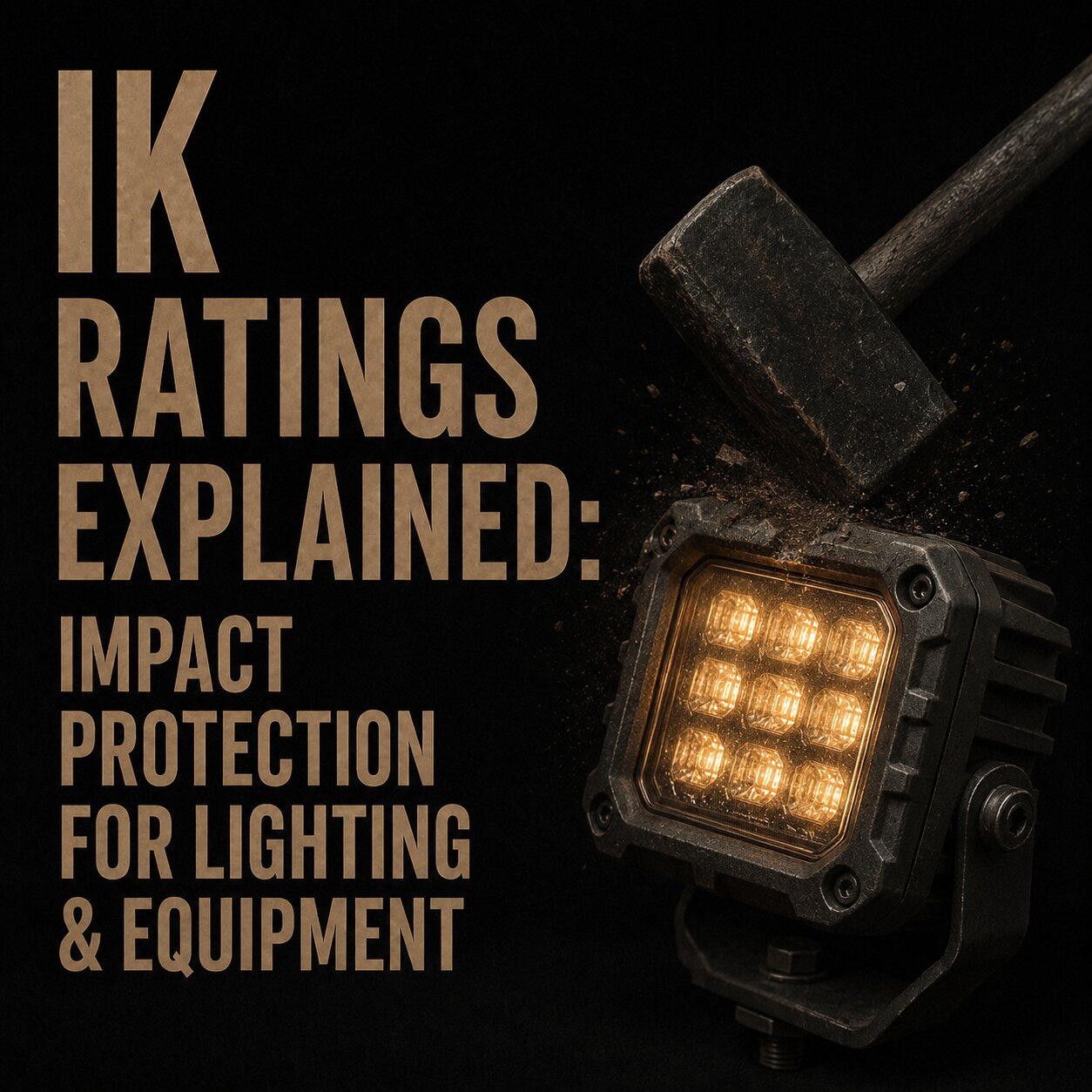
IK ratings measure how well an enclosure protects its contents against mechanical impact. Defined by IEC 62262, they apply to electrical enclosures, lighting fixtures, and electronic equipment across industrial, military, vehicle, and outdoor applications.
If you already know about IP ratings for dust and water protection, IK ratings are the direct companion standard covering physical impact. The two are often specified together.
What Does IK Stand For?
IK stands for Impact Kinetic, referring to the kinetic energy of an impact measured in joules (J). The standard defines a series of ratings from IK00 to IK10, each corresponding to a specific impact energy that the enclosure must withstand without damage to the protected contents.
IK Rating Chart
The table below shows the full IK rating scale with the corresponding impact energy and the equivalent test conditions used to verify compliance.
| IK Rating | Impact Energy | Equivalent Drop Test |
|---|---|---|
| IK00 | Not specified | No protection defined |
| IK01 | 0.14 J | 0.2 kg from 7 cm |
| IK02 | 0.20 J | 0.2 kg from 10 cm |
| IK03 | 0.35 J | 0.2 kg from 17.5 cm |
| IK04 | 0.50 J | 0.2 kg from 25 cm |
| IK05 | 0.70 J | 0.2 kg from 35 cm |
| IK06 | 1 J | 0.5 kg from 20 cm |
| IK07 | 2 J | 0.5 kg from 40 cm |
| IK08 | 5 J | 1.7 kg from 29.5 cm |
| IK09 | 10 J | 5 kg from 20 cm |
| IK10 | 20 J | 5 kg from 40 cm |
IK10 is the highest rating in the standard and represents the most demanding impact protection available under IEC 62262.
What Is IP and IK Rating?
IP and IK ratings address different threats to an enclosure and are independent of each other. A product can carry both ratings simultaneously.
IP ratings, defined by IEC 60529, measure protection against solid particles such as dust and liquids such as water. The two digits in an IP rating indicate dust protection (first digit) and water protection (second digit).
IK ratings measure protection against mechanical impact only. A fixture with IP69K and IK10 is both resistant to high-pressure wash-down and capable of withstanding significant physical impact, which is why both ratings are commonly specified together for outdoor, vehicle, and industrial lighting. For a full explanation of the IP rating system, see our IP ratings guide.
IK Ratings in Practice
IK06 to IK08 cover the majority of commercial and industrial lighting applications. A well-designed outdoor LED fixture or vehicle interior light typically achieves IK08 as a minimum, providing resistance to accidental tool drops and general handling impact.
IK09 and IK10 are specified for applications where deliberate impact, vandalism, or significant mechanical stress is expected. Public area lighting, prison facilities, military vehicle lighting, and outdoor tactical equipment commonly specify IK10 to ensure the fixture remains functional after high-energy impacts.
For vehicle and military applications, IK ratings are typically specified alongside MIL-STD-810, which covers a broader range of mechanical environmental stresses including vibration, shock, and drop testing. Our vehicle lighting range and LED work lights are specified with impact resistance in mind for demanding operational environments.
Frequently Asked Questions
IK10 is the highest rating under IEC 62262, representing protection against 20 joules of impact energy, equivalent to a 5 kg mass dropped from 40 cm. It is the standard specification for high-security, vandal-resistant, and military-grade lighting enclosures.
IK stands for Impact Kinetic. The number that follows indicates the level of protection, from IK00 (no defined protection) to IK10 (20 joules impact resistance). The rating is defined by the international standard IEC 62262.
A higher IK rating indicates greater impact resistance, but specifying IK10 when IK06 is sufficient adds cost and weight without operational benefit. Match the IK rating to the actual impact risk of the installation environment rather than defaulting to the maximum available.