

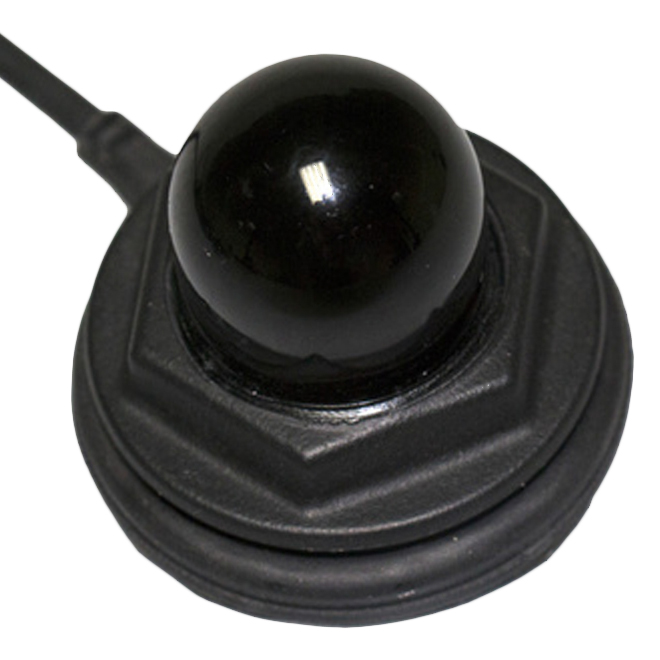
Features
- Covert identification: Output falls outside the visible spectrum, so the vehicle is marked to NVG-equipped friendly forces without showing anything to the unaided eye.
- 850 nm or 940 nm: Choose 850 nm for maximum brightness through NVGs, or 940 nm where the faint red glow visible at the source on 850 nm is unacceptable.
- Unique flash pattern: Each unit is supplied with a distinct pre-programmed pattern, allowing individual vehicles to be told apart within a convoy.
- Long-range air detection: Detectable at over 3 nautical miles from 2,000 ft, giving aircrew positive identification before engagement decisions.
- Deployed in under a minute: Integrated magnetic base and vehicle power plug, no drilling, wiring or permanent fitting.
- Fully encapsulated to IP67: Sealed against dust and water immersion, rated -40 °C to +60 °C for arctic through desert operation.
- 180° x 360° coverage: Full hemispherical output, so the beacon is seen from any approach angle without needing to be aimed.
- Constant-on version available: Steady output rather than flashing, supplied on request.
Applications
- Combat identification and friendly fire prevention
- Military convoy marking and vehicle sequencing
- Air-to-ground identification for rotary and fixed wing overwatch
- Law enforcement and tactical unit operations
- Security and government vehicle identification
- Casualty collection point and rally point marking
The primary role is combat identification. In a contested area at night, an aircrew or overwatch element needs to distinguish friendly vehicles from everything else, and doing so with visible light defeats the purpose of operating in darkness. An IR beacon solves that: positive identification to anyone equipped to see it, nothing at all to anyone who is not.


Specifications
| Model | 47200 |
| Output | Infrared, visible through night vision equipment only |
| Wavelength | 850 nm or 940 nm, specified at order |
| Detection Range | Over 3 nautical miles at 2,000 ft altitude |
| Intensity | Over 180 mW/sr throughout 120° x 360° |
| Flash Pattern | Unique pre-programmed pattern per unit. Constant-on available on request |
| Power Source | 12 VDC |
| Optional Power Source | Vehicle plug adapter, supplied |
| Mounting | Integrated magnetic base |
| Housing Material | High-tech polymer, matte black |
| Dome Lens | High impact polycarbonate, black |
| Environmental Seal | Fully encapsulated unit |
| Ingress Protection | IP67 |
| Operating Temperature | -40 to +60 °C / -40 to +140 °F |
| Storage Temperature | -40 to +80 °C / -40 to +175 °F |
Frequently Asked Questions
Only if they have night vision equipment. Infrared is invisible to the unaided eye, not undetectable. Against an opponent equipped with image intensification the beacon is a clearly visible marker, so it should be treated as covert against unequipped observers rather than as a guarantee of concealment. The 940 nm option removes the faint red glow that is visible at close range on 850 nm units, but neither wavelength is hidden from image intensification. Our article on infrared LED lighting covers this in more detail.
Both are designed for night vision use and both are invisible to the unaided eye at distance. The practical difference is at the source. An 850 nm emitter produces a faint red glow visible up close, which is acceptable in most vehicle marking roles and buys you a brighter, longer-ranged signature through NVGs. A 940 nm emitter removes that glow entirely at the cost of some apparent brightness. Specify 940 nm where someone may be close enough to see the source itself, and 850 nm where maximum range through night vision matters more.
Each unit is supplied with a distinct pre-programmed flash pattern. Within a column, that allows an overwatch element to tell individual vehicles apart rather than simply seeing a line of identical markers, which matters for sequencing, reporting positions and confirming that a specific vehicle is where it is expected to be.
Yes. The integrated magnetic base attaches to any steel surface and the supplied 12 V plug powers it from a standard vehicle socket. No drilling, wiring or permanent fitting is required, so a unit can be moved between vehicles in under a minute.
Yes, and that is the primary use case. The beacon is detectable at over 3 nautical miles from 2,000 ft altitude under night vision observation, with 120° x 360° coverage so it does not need to be aimed at the observer. This is what makes it useful for air-to-ground combat identification.
The unit is fully encapsulated and sealed to IP67, so it withstands dust and water immersion, and is rated from -40 °C to +60 °C in operation. Heavy fog, rain and snow will reduce detection range as they will with any optical system, but the beacon itself is unaffected.

