

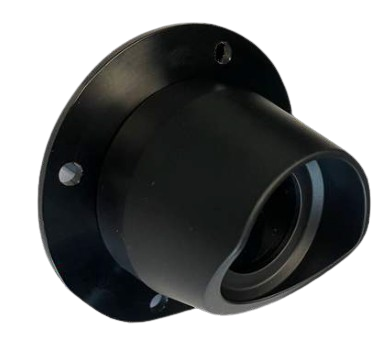
Features
- Night vision driving on dark nights: adds near-infrared light to the scene ahead when starlight and moonlight are too weak for a clear image through the goggles.
- No visible beam: the illuminated area stays dark to the unaided eye, so the vehicle does not show a driving beam to observers without night vision.
- Matched to image intensifiers: the output band sits inside the sensitivity range of both Gen II and Gen III image intensifier tubes.
- Wide flood for the near field: lights a broad area in front of the vehicle, so the driver can pick out track edges, ditches and obstacles across the goggles’ limited field of view.
- Fits where space is tight: a compact head that can be added to grilles, bumpers or custom brackets without major changes to the vehicle.
- One light across platforms: suitable for tactical vehicles, patrol craft and temporary positions on a tripod, which simplifies spares and training.
- Part of a covert lighting fit: works alongside infrared tail, brake and identification lights for convoys that operate on night vision.

What is an infrared driving light?
An infrared driving light is a vehicle lamp that emits near-infrared light instead of visible light. It is used by drivers wearing night vision goggles. The goggles amplify the light that is already there, and US Army night vision driver training notes that their performance depends directly on the available starlight and moonlight. On an overcast, moonless night there may not be enough. The driving light supplies that missing light in a band the goggles can see and the human eye cannot. Read more in what infrared vehicle lighting is and how it works.
The Model 2343 emits between 770 and 840 nm. Second generation image intensifier tubes respond from about 400 nm to about 900 nm, and third generation tubes from about 600 nm to a little over 900 nm, so the band falls well within the working range of both.

Specifications
| Description | Universal IR light 770 to 840nm |
| Input Voltage | 7 – 28 V DC |
| Visibility | 75 – 100 meters |
| Power Consumption | 1.5W |
| Diameter | 52 mm |
| Length | 28 mm |
| Housing Material | Aluminium |
| Housing Colour | Black anodize |
| Mounting Type | Universal Mount |
| Temperature Range | -40 °C to 105 °C |
| Connector or Wiring | Flying lead / Connector on request |
| Standards | IP68, MIL-STD 461G, MIL-STD 810G/H |
| License | No license required |
See the Route on Night Vision Without Showing a Beam
A driver on night vision can only drive as fast as the distance at which hazards can be detected allows. US Army training ties safe speed directly to that detection distance. On a dark night, a wide flood of infrared light in front of the vehicle brings ditches, holes and obstacles back into view, where the goggles alone would show little detail.
Infrared light is covert to the naked eye, not to night vision. US Army training warns that an infrared source makes the user an active emitter that a threat equipped with night vision devices can detect. Use the driving light when ambient light is too low, and switch it off when it is not needed. Because the lower end of the band is close to the visible red, a faint glow may be seen when looking straight into the lamp from close by.
Integration
The light is normally fitted at the front of the vehicle, on the grille or a custom mount, and aimed at the ground ahead. Order 2343-NRI-F when the mounting bracket is required. For a complete night vision convoy fit, combine it with an infrared convoy brake light so the vehicle behind can see you braking, and with lamps from our blackout lighting range for drivers who do not use night vision. The full range of covert lamps is in our infrared lights category.
Frequently Asked Questions
It lets a driver wearing night vision goggles see the route when there is not enough starlight or moonlight for a clear image. The light floods the area in front of the vehicle with near-infrared light that the goggles detect and the unaided eye does not, so the vehicle can move without showing a visible driving beam.
The beam and the area it lights are not visible to the naked eye. Because the lower end of the 770 to 840 nm band is close to visible red, the emitter itself can show a faint red point when viewed head-on from close range. Anyone using night vision devices, including an opposing force, can see the light, so switch it off when it is not needed.
The 770 to 840 nm output lies within the sensitivity range of Gen II image intensifiers (about 400 to 900 nm) and Gen III image intensifiers (about 600 to a little over 900 nm). Response differs between tube types and manufacturers, so we recommend a trial with the devices your drivers use.
Both are the Universal IR light 770 to 840nm. The 2343-NRI-F is supplied with a mounting bracket. Choose the 2343-NRI-B when you mount the light on your own bracket or a custom mount. A connector to match your vehicle harness is available on request.
The light meets MIL-STD 461G, the US military standard that limits the electromagnetic emissions of equipment and tests its resistance to interference. This matters on vehicles where lamps share the power supply with radios and mission electronics. See our guide to MIL-STD-461 for what the tests cover.
