

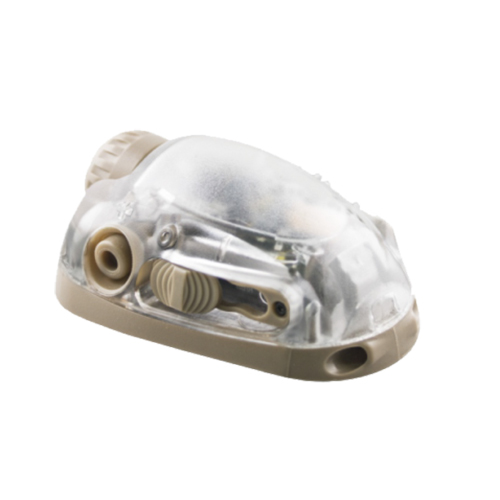
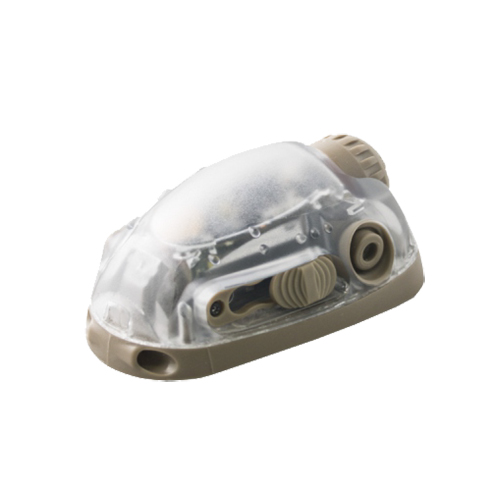

Features
- Visible and covert signalling in one unit: the Trilobyte signals in white, green and red for signalling to the naked eye, and near infrared (NIR) for signalling that only night vision can see.
- Infrared first by default: the first colour mode is NIR, so switching the beacon on in the dark does not give a position away with visible light.
- AutoSync group flashing: Trilobyte beacons of the same model synchronise their flash, so a team shows as one distinct, coordinated group through night vision.
- Mockingbird® programmable signatures: record and play back a unique flash signature from any external near infrared source, including sunlight, with no tools or software.
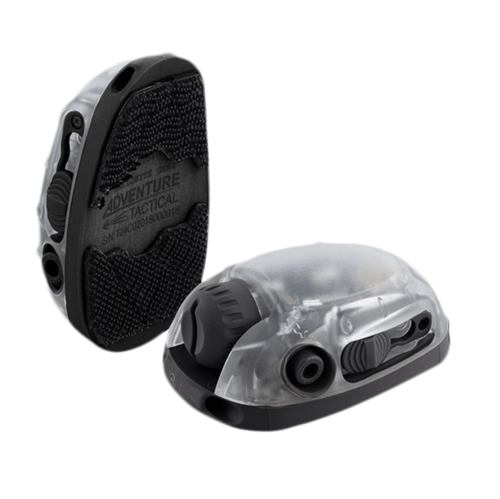
- MultiVibe™ tactile feedback: raised position indicators and vibrating pulses confirm the switch position in total darkness or with gloves on.
- Silent IR detection alert: in IR detection mode the beacon vibrates and flashes briefly when it is struck by a near infrared signal.
- Dual Button Polarity Program Switching: hold the two side buttons to change function group, with no menus to navigate under stress.
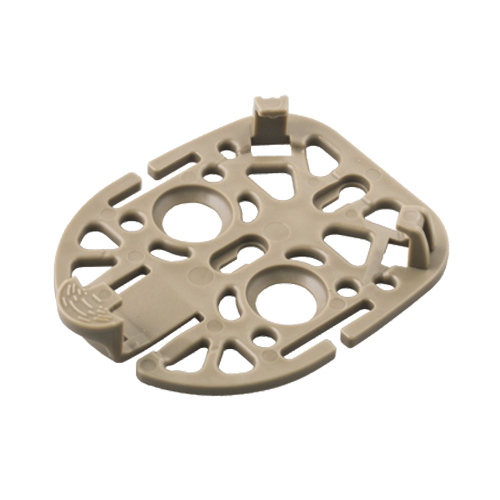
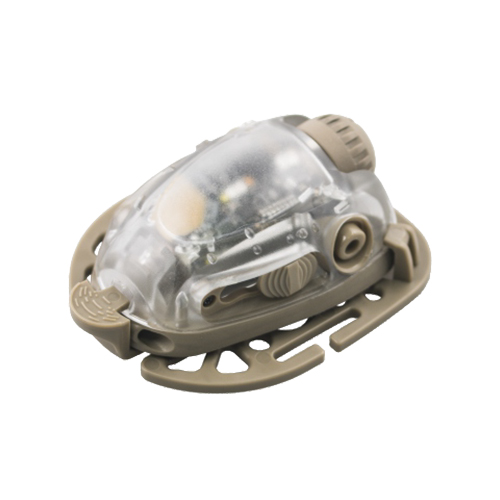
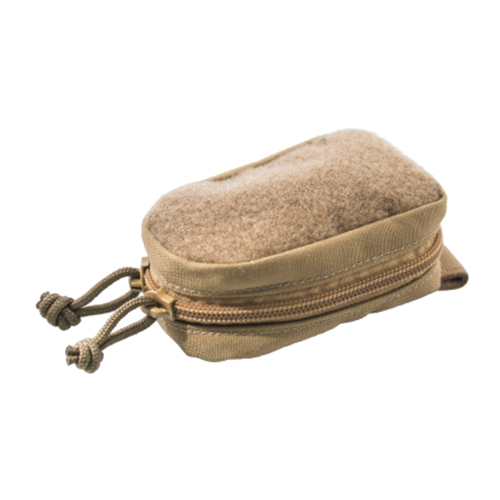
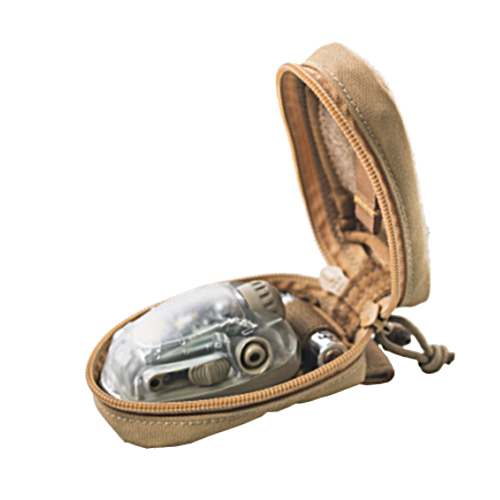
- Flexible fitting: mounts to hook and loop surfaces on the helmet, or to an optional modular VIP pouch or base attachment plate.
What is a helmet light beacon?
A helmet light beacon, often called a helmet strobe or IR helmet marker, is a small light worn on the helmet so that friendly forces can locate and identify an individual soldier. In daylight or under administrative conditions it signals in visible colours. At night, in NIR mode, it is invisible to the naked eye but shows clearly through night vision devices, which is what makes it a combat identification tool rather than a torch.
The Trilobyte helmet light beacon on this page signals in four outputs: white, green, red and NIR. It works alongside passive markers such as IR reflective patches: the patch is seen when someone illuminates it, the beacon is seen because it emits. Both belong to our identification systems range.
Right: continuous light, flash at 48 BPM, off.
Right: constant light, IR detection mode (sleep mode).
Drone Overwatch and SWIR Compatibility
Overwatch drones and aircraft increasingly carry short wave infrared (SWIR) cameras. Their InGaAs sensors respond from about 900 to 1,700 nm, beyond the range of image-intensified night vision goggles. A 1,550 nm signal cannot be seen with current night vision at all, yet it is highly visible to a SWIR camera. That makes SWIR a second, separate marking channel: ground teams follow the NIR signal on their goggles, and a SWIR-equipped drone overhead identifies the same soldier on SWIR.
The four-output Trilobyte described on this page signals in white, green, red and NIR. Where a mission calls for SWIR marking for drone overwatch, the Trilobyte Gen5 NIR/SWIR hybrid (CQB Stealth, 02905-CQB) adds SWIR outputs at 1,064 nm and 1,550 nm alongside NIR at 850/940 nm, with the same synchronised 48 BPM flash and Mockingbird programming. Choose 1,550 nm when the marker should be covert to night vision as well as to the eye, since 1,064 nm can still be seen through current night vision goggles.

Specifications
| Battery Source | One (1) Lithium 1.5V DC (Type: AA) |
| Housing Material | High Impact Polycarbonate |
| Dome Lens | High Impact Polycarbonate (Textured) |
| Housing Finish | Matte |
| Storage Temperature | -40 to +80°C with AA Lithium; -20 to +80°C with Alkaline or Rechargeable AA |
| Operating Temperature | -40 to +80°C with AA Lithium; -20 to +80°C with Alkaline or Rechargeable AA |
| Waterproof Rating | 330 ft / 100 meters / 10 atmospheres |
| Environmental Seal | Fully Sealed Unit |
| Visibility Range | Up to 5 km on High Intensity (Visual or Near IR) |
| Weight | 2.5 oz (72 g) |
| Dimensions | 2.21″ (5.6 cm) x 3.24″ (8.2 cm) x 1.28″ (3.25 cm) |
| Attachment Method | 3M Dual Lock (Installed on Base of Unit) |

Identification That Works in Every Light Condition
Friendly fire at night is largely a problem of identification. A soldier seen through night vision is a shape, and a Trilobyte on the helmet turns that shape into a known friendly. On high intensity the beacon is visible at up to 5 km, in visible or NIR mode, so aircrews, vehicle crews and dismounted teams can find and confirm a friendly position at a useful distance. Vehicles are marked on the same principle with our IR vehicle beacon.
Group and individual identity matter as much as range. AutoSync lets a section flash in unison, while a programmed Mockingbird signature gives one soldier, a team leader or a casualty a pattern of their own. Because every function is set by feel through MultiVibe feedback, none of this needs a light, a screen or bare hands.

Frequently Asked Questions
Yes. In NIR mode the Trilobyte works as an IR helmet strobe, flashing at 48 BPM or giving a continuous light, at low, medium or high intensity. NIR is the first colour mode, so the beacon starts covert. It also has white, green and red outputs for visible signalling.
The model on this page signals in white, green, red and NIR, and its documentation gives no SWIR output. For marking to drones and aircraft with SWIR (InGaAs) cameras, the Trilobyte Gen5 NIR/SWIR hybrid (CQB Stealth, 02905-CQB) adds SWIR outputs at 1,064 nm and 1,550 nm. At 1,550 nm the signal is not visible to current image-intensified night vision but is highly visible to a SWIR camera, so ground teams can follow the NIR signal while overwatch drones follow the SWIR signal. See the Gen5 documentation for details.
Hold the two side buttons to change polarity, then use the left control to record. Mockingbird® technology records the pattern from any external near infrared light source, including sunlight, and plays it back. No tools or software are needed.
