

IR Wavelengths Explained: 850 nm, 940 nm and Beyond
Infrared light is invisible to the human eye, but not all infrared wavelengths behave the same way. The wavelength of an IR source determines how detectable it is, how well it performs with a given night vision device, and how far it can illuminate a scene. Choosing the wrong wavelength means either a compromised image, an unnecessary detection risk, or both.
This article explains the IR wavelengths used in tactical and military applications, what each one is suited for, and how to match a wavelength to your device or use case.
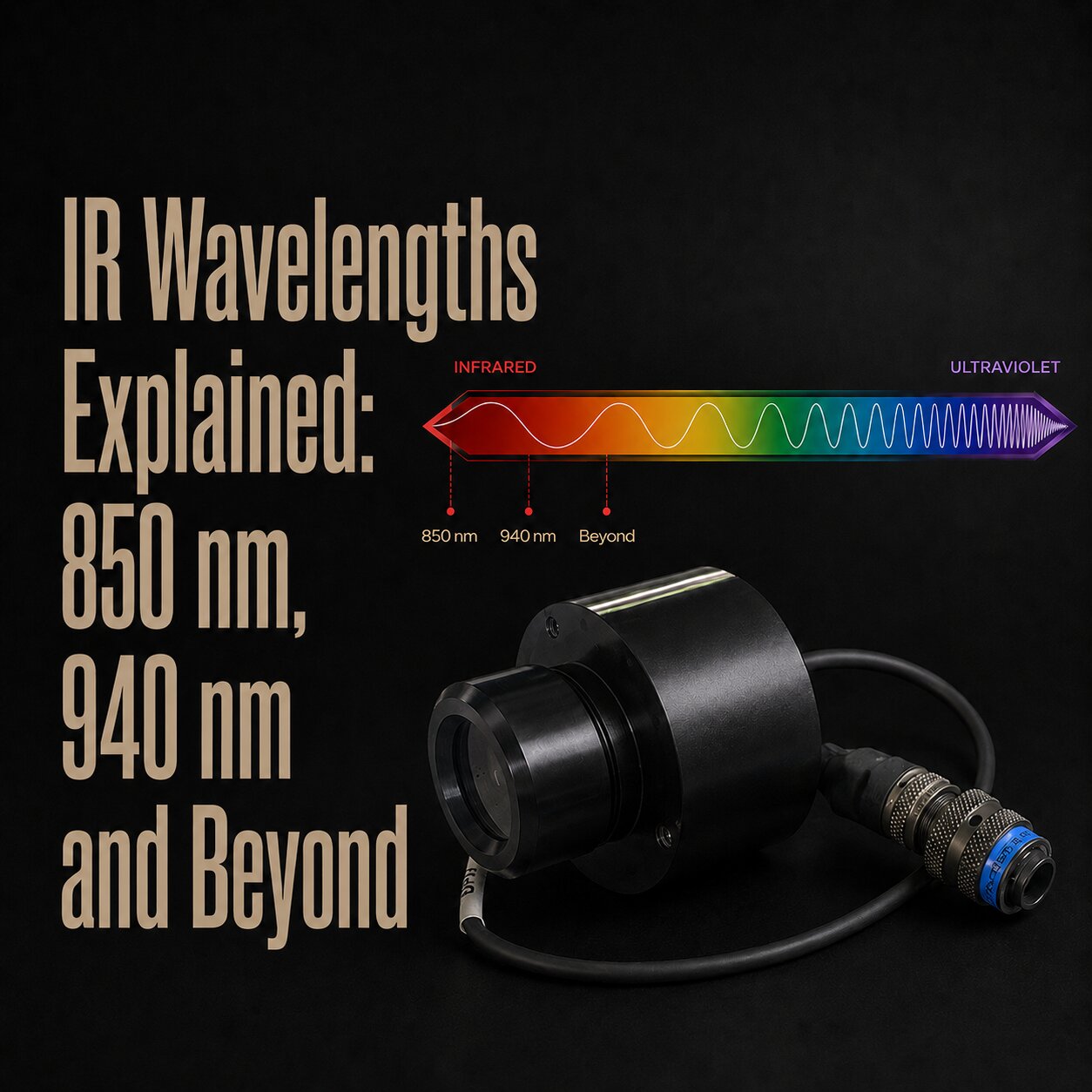
What is the wavelength of IR rays?
Infrared radiation occupies the part of the electromagnetic spectrum immediately beyond visible red light, starting at around 700 nanometres (nm) and extending to 1 millimetre. In tactical and night vision applications, the relevant range is much narrower. The wavelengths used in IR illuminators, NVG-compatible lighting and covert surveillance systems sit predominantly between 850 nm and 1,550 nm.
Within that range, the behaviour of IR light changes significantly. Shorter wavelengths in the near-infrared band are more readily detected by standard image intensifier tubes. Longer wavelengths require specialised sensors but offer greater covertness and, in some cases, better performance through atmospheric obscurants.
850 nm: the standard for NVG-compatible illumination
850 nm is the most widely used wavelength in tactical IR illumination. It sits within the near-infrared band and falls squarely within the peak sensitivity range of Gen 2 and Gen 3 image intensifier tubes. The result is a bright, detailed image through an NVG with relatively modest power consumption from the illuminator.
The trade-off is a faint visible glow. Under the right conditions, the 850 nm emitter can be seen as a dull red point of light by an unaided observer at close range. In most operational scenarios this is not a practical concern, but in environments where proximity to adversaries with no NVG equipment is a risk, it is worth considering.
850 nm is the default choice for vehicle-mounted IR driving lights, helmet-mounted illuminators and weapon-mounted IR lasers. Betalight’s covert IR vehicle illuminator and infrared high/low beam headlight are both available at 850 nm for this reason.
940 nm: covert illumination with a trade-off
940 nm produces no visible glow whatsoever. It is completely invisible to the unaided eye, making it the preferred wavelength wherever covertness is the primary concern and the observer may be close enough to detect a visible glow at 850 nm.
The trade-off is sensitivity. Standard Gen 2 and Gen 3 image intensifier tubes are less sensitive at 940 nm than at 850 nm. The same illuminator at 940 nm will produce a noticeably dimmer image through an NVG than the same unit at 850 nm. To compensate, a higher-powered 940 nm illuminator is typically required to achieve equivalent scene brightness. For this reason, 940 nm is often used for low-speed or static applications rather than high-speed driving where maximum scene illumination is critical.
Betalight’s IR headlight is available in both 850 nm and 940 nm, with the 940 nm version used as the low beam specifically because its covertness outweighs the sensitivity reduction at closer ranges and lower speeds.
Comparing 850 nm and 940 nm
| Characteristic | 850 nm | 940 nm |
|---|---|---|
| Visible glow to unaided eye | Faint red glow at close range | None |
| NVG tube sensitivity (Gen 2/3) | High | Moderate |
| Image brightness through NVG | Higher | Lower (requires more power) |
| Typical use case | High-speed driving, dismounted illumination | Static surveillance, close-range covert use |
| NVG generation compatibility | Gen 1, Gen 2, Gen 3, digital | Gen 2, Gen 3, digital (reduced sensitivity) |
1,064 nm and SWIR wavelengths
Beyond 1,000 nm the standard image intensifier tube cannot detect IR light at all. Wavelengths from 1,000 nm upward require a SWIR-capable sensor. 1,064 nm is widely used in military laser rangefinders and designators. 1,550 nm is considered eye-safe under most operational conditions and is used in high-end covert illumination and certain LIDAR systems.
These wavelengths offer a significant tactical advantage: they are completely invisible to any standard NVG, meaning an adversary equipped only with conventional image intensification equipment cannot detect the IR source. They are also less affected by atmospheric scattering in hazy or smoky conditions.
For a detailed explanation of how SWIR and extended SWIR wavelengths work and where they are used operationally, see the dedicated articles on SWIR technology and E-SWIR. Betalight’s IR illuminator range covers wavelengths from 850 nm to 1,550 nm for both NIR and SWIR applications.
Matching wavelength to your night vision device
The sensitivity curve of your image intensifier tube or digital sensor determines which wavelengths it can use effectively. Gen 2 and Gen 3 analogue tubes peak in sensitivity between 800 and 900 nm, which is why 850 nm is the dominant choice for NVG-paired illumination. Digital sensors vary more widely depending on the chip used, and some are sensitive up to 1,100 nm or beyond.
If you are pairing an IR illuminator with a specific NVG, always check the spectral response curve of the tube against the output wavelength of the illuminator. A mismatch will result in a dim or unusable image regardless of the illuminator’s output power. For guidance on night vision generations and their sensitivity characteristics, see the night vision generations explained article.
Frequently Asked Questions
Standard Gen 2 and Gen 3 image intensifier tubes are most sensitive between 800 and 900 nm, which is why 850 nm is the dominant wavelength for NVG-compatible illuminators. Digital night vision sensors vary more widely and some are sensitive up to 1,100 nm.
Wavelengths above 1,000 nm fall into the SWIR range and require a dedicated sensor. Standard NVG tubes cannot detect them at all.
850 nm produces a brighter image through a Gen 2 or Gen 3 NVG tube because the photocathode is more sensitive at that wavelength. The trade-off is a faint red glow that a nearby unaided observer can detect at close range. 940 nm is completely invisible to the naked eye, making it the more covert option, but it requires more output power to achieve the same scene brightness through an NVG.
For high-speed driving and active illumination, 850 nm is generally the better choice. For static surveillance or close-range covert use where the source must remain undetected, 940 nm is preferable. Betalight’s covert IR illuminator is available in both wavelengths.