

FMVSS 302: Flammability Testing for Vehicle Interior Materials
When you step into a vehicle, whether it is a passenger car, a military truck, or a forklift in a warehouse, you are surrounded by materials that can burn under the wrong conditions. To keep those risks in check, the automotive industry relies on FMVSS 302, the Federal Motor Vehicle Safety Standard that sets requirements for the flammability of interior materials.
This regulation has been in place for decades, yet it still appears in technical specifications, tenders, and procurement contracts. Understanding what FMVSS 302 means, how the test is performed, and where it applies helps procurement officers, safety managers, and vehicle operators make better specification decisions.
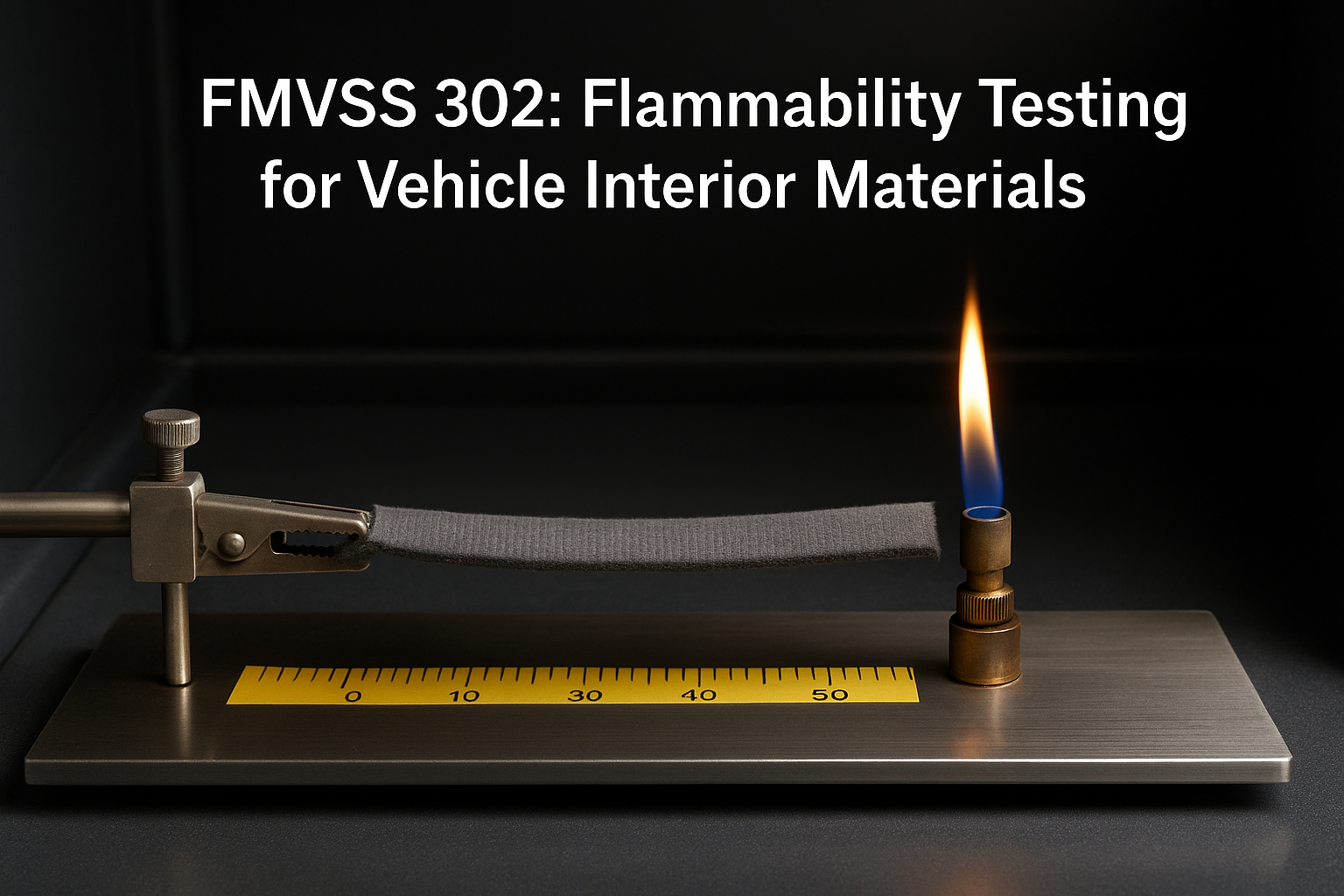
What is FMVSS 302?
FMVSS 302 is specifically about the flammability of interior materials. The rule limits how quickly a material can burn when exposed to a small flame.
The benchmark is straightforward: the burn rate must not exceed 102 millimeters per minute (approximately four inches per minute). By setting this limit, the regulation ensures that materials inside the vehicle give occupants enough time to escape if a fire starts.
The scope covers seat cushions, seat backs, headliners, carpets, sun visors, seat belt webbing, and any other material inside the passenger compartment that could catch fire.
How the FMVSS 302 Test Works
The test method is deliberately simple, which is one reason it has remained in use for decades.
| Step | Detail |
|---|---|
| Sample preparation | A strip of material is cut, typically 356 mm long and 100 mm wide |
| Positioning | The strip is placed horizontally inside a controlled test chamber |
| Ignition | A small flame is applied to one end for 15 seconds |
| Self-extinguishing check | If the flame goes out before traveling 38 mm, the material passes automatically |
| Burn rate calculation | If the flame continues, burn rate is measured and must be at or below 102 mm per minute to pass |
The horizontal orientation and defined flame size produce consistent, reproducible results that allow material comparisons across suppliers and test facilities.
FMVSS 302 Requirements: Where the Standard Applies
Civilian vehicles All passenger cars, trucks, buses, and multipurpose vehicles sold in the US must use interior materials meeting FMVSS 302. This covers original equipment and, in practice, is expected of aftermarket replacement materials used in the same locations.
Industrial and construction vehicles Forklifts, construction machines, and mining equipment operating in environments with elevated fire risk rely on FMVSS 302 as a baseline compliance reference even where it is not legally mandated.
Military and defense vehicles FMVSS 302 frequently appears as a baseline requirement in military vehicle specifications before additional, more stringent military standards are applied. A troop carrier or armored vehicle may face combat fire risks beyond what FMVSS 302 addresses, but interior materials still need to meet the basic flame spread requirement as a starting point. For the broader environmental and durability standards applied to military vehicle components, see our MIL-STD-810 guide.
Aircraft FMVSS 302 is referenced in some aircraft interior applications, particularly for ground support and military aviation vehicles where the standard appears in procurement specifications alongside aviation-specific flammability requirements such as FAR 25.853.
FMVSS 302 vs Other Flammability Standards
| Standard | Scope | Test Orientation | Common Use |
|---|---|---|---|
| FMVSS 302 | Vehicle interiors (US) | Horizontal | Cars, trucks, buses |
| ISO 3795 | International equivalent | Horizontal | Global automotive |
| ECE R118 | Bus and coach interiors (EU) | Horizontal and vertical | Public transport |
| UL 94 | Plastics in electronics | Horizontal and vertical | Electrical and consumer goods |
FMVSS 302 vs UL94 is a common question in procurement. The key difference is scope: FMVSS 302 is specific to vehicle interior materials tested horizontally, while UL 94 applies to plastics used in electrical and electronic equipment and uses both horizontal and vertical burn tests. A material can comply with both standards, but compliance with one does not automatically imply compliance with the other.
For cross-regional procurement, passing FMVSS 302 often supports compliance under ISO 3795 given the similar test methodology, but separate test reports are typically required.
FMVSS 302 in Electric and Hybrid Vehicles
Battery-related fire incidents in electric and hybrid vehicles present different hazards than a burning seat cushion. However, if a battery fire spreads into the cabin, the time occupants have to escape depends directly on whether interior materials meet FMVSS 302.
Military planners face similar considerations with next-generation hybrid and electric armored vehicles. The principle is consistent: slowing fire spread inside a confined space buys critical seconds for survival regardless of the fire’s origin.
For broader vehicle lighting and safety standards applicable to military and commercial platforms, see our articles on FMVSS 108 and DOT vs ECE vs SAE lighting standards.
Frequently Asked Questions
They are functionally equivalent standards using the same horizontal burn test method and the same 102 mm per minute pass criterion. FMVSS 302 is the US federal regulation while ISO 3795 is the international standard. Most test laboratories run both simultaneously from a single test sample, and many test reports certify compliance with both standards from one set of results.
The full FMVSS 302 text is available through the Electronic Code of Federal Regulations at ecfr.gov under Title 49, Part 571, Section 571.302. It is also accessible through the National Highway Traffic Safety Administration website at nhtsa.gov.
No. FMVSS 302 applies only to materials used inside the passenger compartment. Exterior body panels, under-hood components, and other external parts are not covered by this standard. Separate fire safety standards apply to specific exterior components where required.