


Features
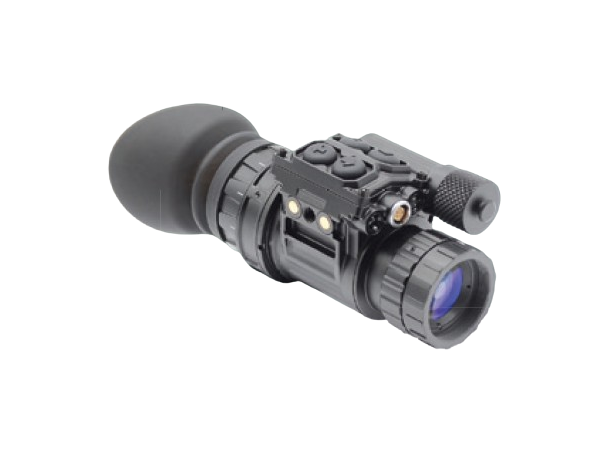
- Ultra-lightweight at 202 grams – One of the lightest night vision monculars available in its class, significantly reducing operator fatigue during extended use
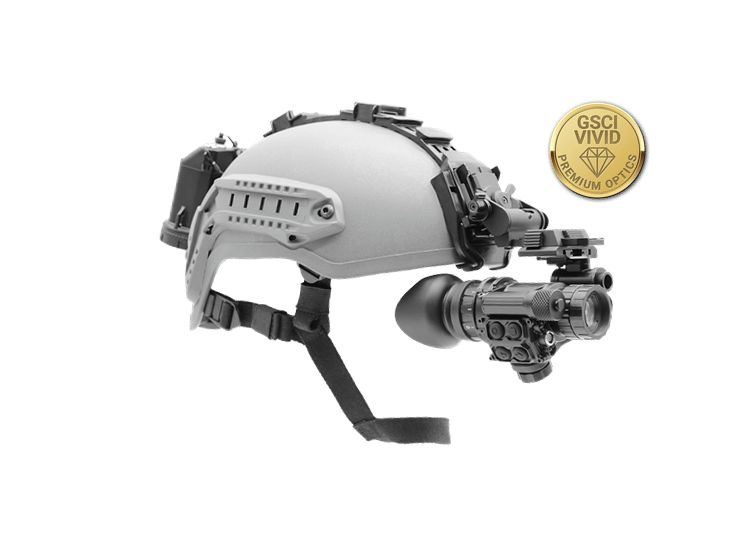
- Multiple mounting options – Compatible with helmet mounts, weapon rails, and tripods, covering handheld, head-mounted, and weapon-mounted operational roles from a single device
- Built-in IR illuminator – Provides active illumination in complete darkness without carrying a separate IR device, extending operational capability in zero ambient light conditions
- Up to 240 hours battery life – AA battery provides up to 40 hours of runtime. The optional MVP-240 multi-voltage battery pack extends this to 240 hours for extended deployments
- Stow safety and flip-up-off – Conserves battery and prevents accidental activation when not in use, reducing power consumption and maintaining operational readiness
- 7-year limited warranty – Backed by GSCI Advanced Photonics with local maintenance support

Image Intensifier Tube Options
| Tube Type | Performance Level |
|---|---|
| Gen 2+ | Entry-level military grade, good low-light performance |
| Gen 3 | High sensitivity, optimized for starlight conditions |
| ECHO | Enhanced performance Gen 3 equivalent |
| ECHO Elite | High-grade performance with extended FOM range |
| 4G | High-performance tube with FOM up to 2400+ |
| 4G Elite | Premium performance, green or white phosphor |
| 4G Elite Plus | Highest available specification, FOM 2400+ |
All tube options are available in green or white phosphor configurations. White phosphor provides a more natural black-and-white image with improved contrast and reduced eye fatigue during extended operations. For more on white phosphor vs green phosphor, see our military night vision goggles page.
Specifications
| Lens System | 27mm, f/1.2 |
| Diopter Adjustment Range | -6 to +2 |
| Optical Magnification | 1× |
| Field of View (FOV) | 40° |
| IR Illuminator | Built-in |
| Bright Light Sensor | Built-in |
| IR LED Indicator | Yes |
| Bright Light LED Indicator | Yes |
| Low Battery LED Indicator | Yes |
| Stow Safety Feature | Yes |
| Flip-Up-Off Feature | Yes |
| External Power Port | Optional |
| Power Source | 1× AA battery or MVP-240™ external pack |
| Battery Life (AA) | Up to 40 hours |
| Battery Life (MVP-240™) | Up to 240 hours |
| Environmental Protection | Waterproof |
| Operating Temperature | -40°C to +50°C |
| Dimensions | 109 × 58 × 51 mm |
| Weight | 202 grams (excluding image intensifier tube) |
| Warranty | 7 years, limited |
Optional Accessories
Enhance the functionality of your LUX-14™ with the following accessories:
-
GSCI-VIVID Premium Optics
-
GR8™ Advanced Helmet Mount
-
J-Arm Adapter Interface
-
MVP-240™ Multi-Voltage Battery Pack
-
IR-250S Tactical Infrared Illuminator
-
3× and 5× Afocal Add-On Objective Lenses
-
Smartphone Camera Adapter CAS-14
We offer matching IR lights for these night vision goggles, click the button below the explore matching IR lights.

Frequently Asked Questions
The LUX-14 meets military grade requirements through its nitrogen-purged aluminum housing rated for -40°C to +50°C, compatibility with Gen 3 and 4G Elite series image intensifier tubes, digital push-button controls operable with tactical gloves, and its 7-year warranty backed by local maintenance support. It is developed by GSCI Advanced Photonics, whose products are used by NATO-aligned military and law enforcement forces.
A night vision monocular uses a single optical channel and is designed for one eye. It is lighter and more compact than dual-tube goggles, making it better suited for handheld observation, weapon mounting, and situations where pack weight is critical. Night vision goggles use two optical channels for binocular vision with genuine depth perception, which is better for extended navigation and movement. The LUX-14 covers the monocular role while the PVS-31C-4B covers the dual-tube goggle role.
The LUX-14 uses image intensification technology rather than digital sensor technology. Image intensification amplifies available light through a physical intensifier tube, delivering faster response and more natural imagery than digital systems. Digital night vision monculars use a digital sensor and display, which can offer recording capability but typically have higher latency and different image characteristics.


